
Masters 2024 Course Preview and Betting Trends
Geoff Ulrich previews everything you need to know about Augusta National for the 2024 Masters as well as the biggest Masters betting trends to watch.
Masters 2024 Course Preview and Betting Trends
On top of being the most picturesque and viewer-friendly event of the season, the Masters is also one of the most unique tournaments for players. Augusta National is an insanely private golf club that puts massive resources into preparing its course for this week, and the result is a course cut to a level of perfection we rarely see anywhere else.
While some players thrive on these conditions (Spieth, Woods etc) for most there is a steep learning curve to understanding how to get around the course successfully.
With this in mind, our early-week analysis will focus on a full-length course preview and relevant betting trends to help us narrow down an early-week betting target (read on to find out who)...
Masters 2024 Course Preview
- Augusta National Golf Club (Augusta, Georgia)
- Par: 72, 7,545 yards
- Greens: Bentgrass
- Design: Dr. Alister MacKenzie and Robert Tyre Jones, Jr. (1933)
- Course Record: 63 (Nick Price, Greg Norman)
- Most wins: Jack Nicklaus; six
- Defending Champion: Jon Rahm
Augusta National is the only course that hosts a major championship every season. That means that course history and experience tend to play a far bigger role at this week’s event than it does at other majors. The venue plays as a traditional Par 72 – measuring in at a lengthy 7,545 yards last season – and features some of the fastest Bentgrass greens on Tour.
The course hasn’t been changed much for 2024 but the tee box on the Par 5, 2nd hole (typically one of the easiest holes) has been pushed back 10+ yards or so, making the tee shot more difficult and more important than it was in previous seasons. Augusta has been finding room to push back tee boxes on some of their easier holes and recently it has catered more to off-the-tee specialists as a result.
While Augusta has numerous quirks and intricacies that make it difficult for even the best pros, the venue can be broken down more simply by groupings:
The scoring holes
The Par-5s at Augusta all play relatively easy and are generally the four easiest holes on the course.
The short Par-4 3rd hole, which plays between 300-350 yards, has a tricky green but is a genuine birdie opportunity that often plays right at par or just under it (for average score). Around the green play can often be crucial at the 3rd. Longer hitters will leave themselves with just a long chip after their tee shot, and the smaller green means that approach shots can and will roll off, and leave players with delicate comeback chips.
The short Par-3 16th, well known for its dramatic Sunday pin position, can also be placed into this grouping of holes. It often has an advantageous pin placement on Sunday and played as the sixth easiest hole in 2019 (the easiest Par-3 on the course).
Amen corner
This is the well-known nickname given to holes 11, 12, and 13 at Augusta. The name is derived from the fact two of these holes can often play as the most difficult on the course.
Recently, the long Par-4 11th was lengthened to 510 yards and now plays as the single most difficult hole on the course, and has yielded the worst scoring average of all the par 4s on the course the past few seasons. This long Par-4, which measures in at just over 500 yards, starts with one of the more difficult tee shots on the course and includes a small dogleg into a semi-island green. Approaches that land short can often bounce into the hazard due to the generous sloping around the greens.
The 12th, Golden Bell, is a diabolical and short, 155-yard Par-3 with a narrow green that Nicklaus called the hardest tournament hole in golf. It has most recently led to the self-destruction of final-round leaders in both 2016 (Jordan Spieth) and 2019 (Francesco Molinari).
The Teeth of the Course
Augusta contains five Par-4s that measure in at over 450 yards in length and only one that plays shorter than 440 yards. These are the teeth of the course, along with a couple of tough Par 3s, which players must navigate in order to set up their chances at birdie or better on the scoring holes.
With so much on the line, it’s also no shock that two of the tougher holes over the years have been the long Par-4 17th and the finishing Par-4 18th, which has an incredibly narrow driving chute. These two typically play above average in terms of toughness and yield scoring averages well over par for the week.
Course stats
Augusta has a lot of tough features but one of the quirks about the course is that it doesn’t typically feature lengthy rough and has some of the most generous fairways on the PGA TOUR.
However, Augusta is also extremely undulating and has greens with steep drop-offs that tend to play extremely firm, even if there has been rain. Hence, GIR% and Scrambling% are typically much lower than the PGA average and there is a huge premium on both GIR% and around the green play.
Additionally, because of the slopey greens and fast speeds, gauging Augusta's green speeds is a difficult endeavor. Three-putt percentages typically go way up at Augusta as good lag putting becomes extremely important for this week.
- Driving accuracy – easy
- Scrambling – difficult
- GIR% – difficult
- Three-putt avoidance – extreme
Augusta National Winners trends and stats
Last three winners of the Masters (Rahm 2023, Scheffler 2022, Matsuyama 2021):
- All led the field in SG: TTG stats in year of their win
- Each of the last three winners were top 10 in GIR%
Recent statistical form of the last three winners (in their final four starts before Augusta):
- Each of the last three winners had accomplished the following
- Gained over 2.0 strokes on approach in multiple starts
- Gained over 2.0 strokes around the green in at least one start
- Gained over one stroke putting in at least one start
2024 Masters betting facts and stats
Below are the previous odds (week of) of the past 10 Masters winners. A couple notes about these odds below:
- Three of the past four winners have had closing odds under +2000
- Three players have won with closing odds of +4000 (or bigger) over the past decade, but the biggest pre-event closing odds over the past decade were +5000 (Willett 2016 and Matsuyama 2021)
- By contrast, four players with closing odds between +900 to +1200 have won this event over the past decade
Below is the previous 10 winners of the Masters and their pre-event odds from the beginning of the week of the event. (Odds courtesy of SportsOddsHistory.)
| Name | Year | Betting odds |
| Jon Rahm | 2023 | +900 |
| Scottie Scheffler | 2022 | +1800 |
| Hideki Matsuyama | 2021 | +5000 |
| Dustin Johnson | 2020 | +1000 |
| Tiger Woods | 2019 | +1200 |
| Patrick Reed | 2018 | +4000 |
| Sergio Garcia | 2017 | +3000 |
| Danny Willett | 2016 | +5000 |
| Jordan Spieth | 2015 | +1000 |
| Bubba Watson | 2014 | +2000 |
Masters Betting trends
Below are some general trends we have seen from past Masters winners. Trends aren’t a great thing to follow blindly in handicapping but they can be useful for tie breaking scenarios and tend to carry more weight in golf betting at events where course history plays a bigger role.
Below are some of the more relevant Masters betting trends for 2024.
Players who miss the cut the year prior at the Masters
- Since 1996, only one player has won the Masters after missing the cut at Augusta the previous year (Patrick Reed 2018).
First-time major winners at the Masters
- 12 of the last 20 winners at Augusta have been first-time major winners
Age of Masters winners
- Over the last 20 years, the average age of the Masters winner is approximately 31.0 years old.
- 9 of the last 10 Masters winners have been under the age of 40 (exception: Woods 2019)
Course experience of Masters winner
- The last debutant (first-time Masters starter) to win at Augusta was Fuzzy Zoeller in 1979
- 14 of the previous 15 winners had achieved at least a top 30 finish at Augusta National in a previous season (before winning)
- 8 of the last 11 winners of the Masters had achieved a top-five finish at the Masters in a previous season (before winning)
Recent form of Masters winners
- The last 10 winners of the Masters had all recorded a top 20 finish in at least one of their last three events
- 9 of the last 10 winners of the Masters had recorded a top five in one of their last five events
- 7 of the last 9 winners had recorded a T2 or better in the four months prior to winning at Augusta
- 4 of the last 6 winners had recorded a T2 or better in one of their previous three PGA starts before winning at Augusta
Recent statistical form of the last three winners (in their final four starts before Augusta):
- Each of the last three winners had accomplished the following
- Gained 2.0 strokes or more on approach in multiple starts
- Gained 2.0 strokes or more around the green in at least one start
- Gained 1.0 stroke or more putting in at least one start
How many back to back winners have there been at the Masters?
- It has only happened three times: Nicklaus 1965-66, Nick Faldo 1989-90 and Woods 2001-2022
Early week betting target: Tony Finau Outright (+4500; FanDuel)
- Top 10 (+410; FanDuel)
Tony Finau fits all the trends we posted above. He’s 34 years old, which places him within 3.0 years of the average winning age and under 40 years of age (nine of the past 10 winners have been under 40). He’s never won a major (12 of the last 20 winners at Augusta have been first-timers) and didn’t miss the cut at Augusta last season either (T38).
Not only has Finau finished inside the top 30 at Augusta multiple times (something 14 of the past 15 winners had already done) but he’s also achieved a top 5 at Augusta (T5-2019) something that eight of the last 11 winners of this event had achieved before winning.
Taking it one step further, Finau also fits every recent form trend we noted above, both from a results and statistical perspective. With his T2 in Houston two weeks ago, Finau matches what four of the last six winners at Augusta had achieved, a T2 or better finish in one of their last three starts.
Statistically, he has gained over 2.0 strokes on approach in two of his last four starts, gained over 2.0 strokes around the green in his final start in Houston, and gained over 1.0 strokes putting three starts ago at THE PLAYERS. This aligns him nicely with the stat trends from each of the past three winners we noted above.
Finau’s lead-up to Augusta from a statistical perspective (data via Fantasy National)
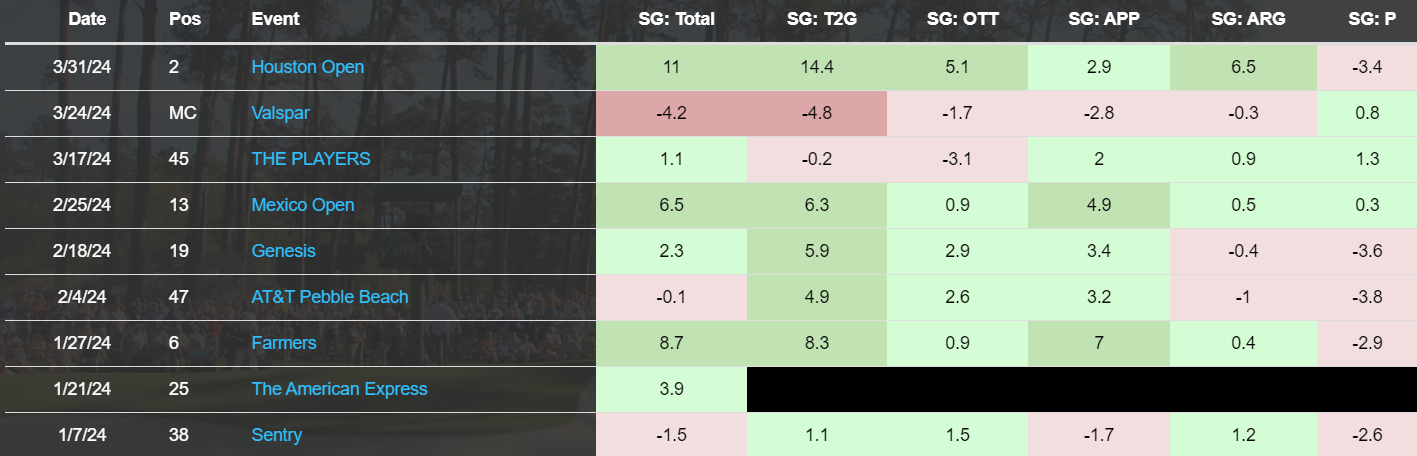
On top of being a solid trend fit, Finau also looks like a good value option from a price perspective. Last season he closed well under +3500 in the outright odds but was coming in with significantly poorer form (he hadn’t posted a top 10 in his lead-up and hadn’t been nearly as good around the green).
So the fact we can still bet the 34-year-old at a price above what he was at last year, despite his form being significantly better, makes him quite appealing for me in 2024.