The former No. 9 overall NFL Draft pick has an outstanding 30% target share and 46% air yards share. He rarely leaves the field with a 96% route participation rate.
We are only two games in, so the sample is small, but Odunze's historical Utilization comps have smashed. Since 2020, WRs with a Utilization Score between 90 and 100 have averaged 21.3 points per game, with 100% of them finishing as top-six options.
The Bears' passing attack still isn't thriving, and the battle for targets could increase as the rookies find their legs, but right now Odunze is dominating.
Odunze UPGRADES to WR2 status and will enter WR1 territory if he keeps his Utilization Score over 90 in the next two games.
2. Tucker Kraft is the No. 1 receiver in Green Bay.
The third-year TE has morphed from an underneath yards-after-the-catch (YAC) monster into a weapon who can also attack downfield and add to the catch with a 9.8 average depth of target (aDOT). Kraft is averaging 9.1 yards after the catch (2nd) and 17.5 yards per reception.
Since 2020, TEs with a similar Utilization Score have averaged 12.2 fantasy points per game, with the majority posting a TE4 to TE6 finish.
TE1 to TE3 season: 21%
TE4 to TE6 season: 43%
TE7 to TE9 season: 29%
TE10 to TE12 season: 7%
With Jayden Reed now out for at least six weeks due to a collarbone injury, the competition for targets in Green Bay is as low as ever with Matthew Golden still stuck in a part-time role.
Kraft UPGRADES to top-six TE status and offers top-three upside.
3. Javonte Williams is running away with the Dallas backfield.
In Week 1, the cope was firm among the Williams haters—he wasn't efficient. Welp. Throw that out the window. Williams ranks 11th in rushing yards per attempt (4.6) and yards after contact (3.4) after two contests. He has galloped for 10-plus yards on 12% of his attempts (9th).
With a defense that can't stop anyone and a passing attack that should provide the run game with plenty of scoring chances, Williams is in a strong situation for the foreseeable future—Jaydon Blue was inactive again in Week 2.
Williams' closest Utilization Score comps averaged 16.9 fantasy points per game. They were all top-18 options.
RB1 to RB6 season: 40%
RB7 to RB12 season: 35%
RB13 to RB18 season: 25%
Williams UPGRADES to borderline RB2 status, and there is a version of 2025 where he cracks the top-six.
4. Buy-low targets: Brian Thomas Jr. and Josh Jacobs.
You know what that sounds like to me? A great chance to buy low on a player who was one of the best receivers in the NFL to finish 2024.
While others worry about his performance, let's keep in mind that Trevor Lawrence—who has a vested interest in throwing the ball to his best players—has peppered this man with nine targets (26%) and 127.5 air yards per game (46%).
Since 2012, 41 WRs have averaged between eight and 10 targets per game with 115 to 140 air yards per game. Their average fantasy finish was WR12 with 17 points per game.
WR1 to WR6 seasons: 15 of 41 (37%)
WR7 to WR12 seasons: 11 of 41 (27%)
WR13 to WR18 seasons: 6 of 41 (15%)
WR19 to WR24 seasons: 5 of 41 (12%)
WR24 or lower seasons: 4 of 41 (10%)
So 64% of the time, this type of player has been a top-12 option, and the most significant cohort were WR1 to WR6 finishers.
I know some of you are wondering about the non-top-24 finishers, so here is the list:
Allen Robinson II (2014): 12.3 PPG, WR34 finish
Mike Wallace (2013): 12.5 PPG, WR27 finish
Terrelle Pryor Sr. (2016): 13.1 PPG, WR25 finish
Vincent Jackson (2014): 11.4 PPG, WR40 finish
The sharp move is to bet on BTJ's performances turning around over a larger sample of games. Securing Thomas at a low-end WR1 price leaves room to profit, and anything below that could be a homerun considering the historical hit rates.
Josh Jacobs | Packers
It was a little later than this, but Jacobs was one of my top buy-low candidates in 2024. The circumstances were eerily similar, with Jacobs dominating the Packers' backfield but not dominating the box scores.
Through two games, Jacobs is averaging 14.2 points per game, but he is bogarting all of the RB work in Title Town. The veteran back has accounted for 84% of the rushing attempts (21 per game) with an 82% snap share. He shares some time in the receiving game but still offers a healthy 54% route participation.
Since 2012, RBs who averaged 19 to 23 attempts per game have finished as the RB5 on average with 19.5 points per game.
RB1 to RB6 finishes: 22 of 31 (71%)
RB7 to RB12 finishes: 7 of 31 (23%)
RB13 to RB18 finishes: 2 of 31 (6%)
We can also expect some positive regression in the target department, given the woes at the WR position for the Packers. Jacobs posted a 9% target share in 2024.
On a team with a potent offense and a high-powered defense, things set up well for Jacobs and his TD upside. Last year, Jacobs averaged 10.8 points over the first four games before averaging 19.8 points from Week 5 through the fantasy championship in Week 17.
Jacobs profiles like a 20-point-per-game option, making him a great player to kick the tires on with a trade offer.
5. How does the fantasy outlook change for Ja'Marr Chase and Tee Higgins without Joe Burrow?
Including the Week 2 game, we now have an eight-game sample where Jake Browning played at least 70% of the snaps since 2023. Below is how he stacks up with Burrow.
Passing yards per game: 263 yards
Burrow: 279
Browning: 263 (-5%)
Passing TDs per game:
Burrow: 2.1
Browning: 1.6 (-24%)
While Browning is obviously a step down from Burrow, he has kept things respectable.
Chase has played over 70% of the passing plays in seven of those eight games, averaging 15.9 points. However, scored 12 points or less in five of seven games.
Higgins played over 70% of the passing plays in six of eight games with Browning. He averaged 17.7 points. He scored 12 points or fewer in two games.
The main takeaway here isn't to say Higgins is better than Chase with Browning—the sample is too small. The overarching takeaway is that while both WRs take a hit without Burrow, they don't deserve massive downgrades.
Ja'Marr Chase DOWNGRADES to mid-range WR1 territory andTee HigginsDOWNGRADES to borderline WR2 territory.
Through two games, we have some offenses leaning heavily into the ground game. Unfortunately, all three of the most run-heavy units have talented WRs on their team who are suffering.
Jets: -14.7% dropback rate over expected (DBOE)
Vikings: -6.5% DBOE
Eagles: -6.3 DBOE
Not only do these teams run a ton, they have QBs who turn many of their precious dropbacks into scrambles.
It's hard to keep players like Wilson and Jefferson (41% and 33% target shares) down in the Utilization Score, but that is precisely what is happening in these gross offenses. You guys have lived the pain before with Smith and Brown. Welcome to Chapter 2.
Wilson is a boom-bust high-end WR3.
Jefferson DOWNGRADES to mid-range WR1 territory and will fall to the low-end WR1 zipcode if the Vikings don't change over the next two games. We could see something different with McCarthy expected to miss two to four games with a high-ankle sprain. Carson Wentz will start.
Smith DOWNGRADES to low-end WR3 territory and is heading for WR4 status if the Eagles don't change.
Brown DOWNGRADES to mid-range WR2 territory.
7. TreVeyon Henderson and RJ Harvey: Bench banishment.
Let me begin with a sincere apology to everyone who followed my advice and drafted Henderson or Harvey. I go through an extensive process to craft my rankings, but I am an aggressive drafter and pushed the envelope too far on Henderson.
My biggest hangup is that I took Henderson over proven players like James Cook so often, despite being aware of the uncertainty surrounding Henderson's role. We want to embrace uncertainty, but not at all costs. As Henderson's price tag rose, I should have adjusted.
Having said that, I stuck it out with rising price tags on Malik Nabers and Jayden Daniels last year, and it paid off. I don't know that there is a perfect answer to a game where perfection is impossible. The best approach lies somewhere in between, and it is something I plan to reflect upon more this offseason.
So what do we do now? Wait.
It's the only profitable approach. The good news: nothing has changed about Henderson or Harvey's profiles. They are talented players who still have a lot of outs. If we sell now, we will gain nothing, and we will be devastated if/when they take on larger roles.
We have a similar situation in Denver with J.K. Dobbins leading the way and Tyler Badie transforming the backfield into a three-way split instead of two.
Stevenson and Harvey DOWNGRADE to borderline RB3 status until we see signs of a change.
8. Five fantasy backfields that could be evolving.
Giants: A new RB1 in town?
In Week 1, Tyrone Tracy dominated New York's backfield. However, it was Cam Skattebo leading the way in Week 2. The rookie garnered the most snaps with 51% and led the team in rushing attempt share at 55%. Tracy retained the two-minute work, but Skattebo equalled him in route participation at 42%.
It's hard to know how the Giants will handle their backfield moving forward; it could be a hot-hand approach. Still, there is a chance Skattebo has moved into the driver's seat after only one game.
Skattebo UPGRADES to mid-range RB3 status and is available in 40% of Yahoo leagues.
Cardinals: Turning into a 1A/1B scenario?
In Week 1, Conner handled 64% of the snaps versus 34% for Benson. That evolved into a 52% versus 48% split in Week 2, with Benson taking over as the Cardinals' lead pass-down back.
Through two games, Conner still holds a significant lead over Benson in total opportunities.
Conner: 11.5 attempts per game + 2.5 targets per game → 14 total per game
Benson: 5.5 attempts per game + 3 targets per game → 8.5 total per game
For the season, the snap share is 59% versus 40% for Conner and Benson, respectively. Conner's closest Utilization Score comps have averaged 13 fantasy points per game, with 60% of them finishing between RB24 and RB30. We saw 23% carve out an RB7 to RB18 finish.
Conner DOWNGRADES to low-end RB2 status. Benson UPGRADES to RB4 territory and should be rostered in most formats—he is available in 48% of leagues.
Browns: The return of Quinshon Judkins.
Jerome Ford led the team with a 49% snap share, but how long he can maintain that seems very shaky given that Judkins led the team in attempts after one week of practice. The rookie handled 48% of the rushing attempts, scoring 10.1 fantasy points.
We could see a three-way committee continue for the immediate future, but expect Judkins to take over the early-down work sooner rather than later.
Judkins UPGRADES to low-end RB3 status and offers RB2 upside once in his full role. He is available in 40% of leagues.
Dylan Sampson and Jerome Ford will joust for the RB2 duties—hopefully, they don't share them. In that scenario, they would both be worthless.
Jaguars: A new RB2 with Tank Bigsby gone.
Bhayshul Tuten stepped into the RB2 role with a 31% rush share on his way to 15.4 fantasy points in Week 2 against the Bengals. He didn't play much on passing downs with a 13% route participation, but was heavily targeted when on the field with a 33% targets per route run (TPRR).
Travis Etienne Jr. is locked as the No. 1 back for the Jaguars and is a mid-range RB2.
Tuten UPGRADES to RB5 territory and should be rostered in all leagues—he is the primary cuff to Etienne. He is available in 45% of leagues.
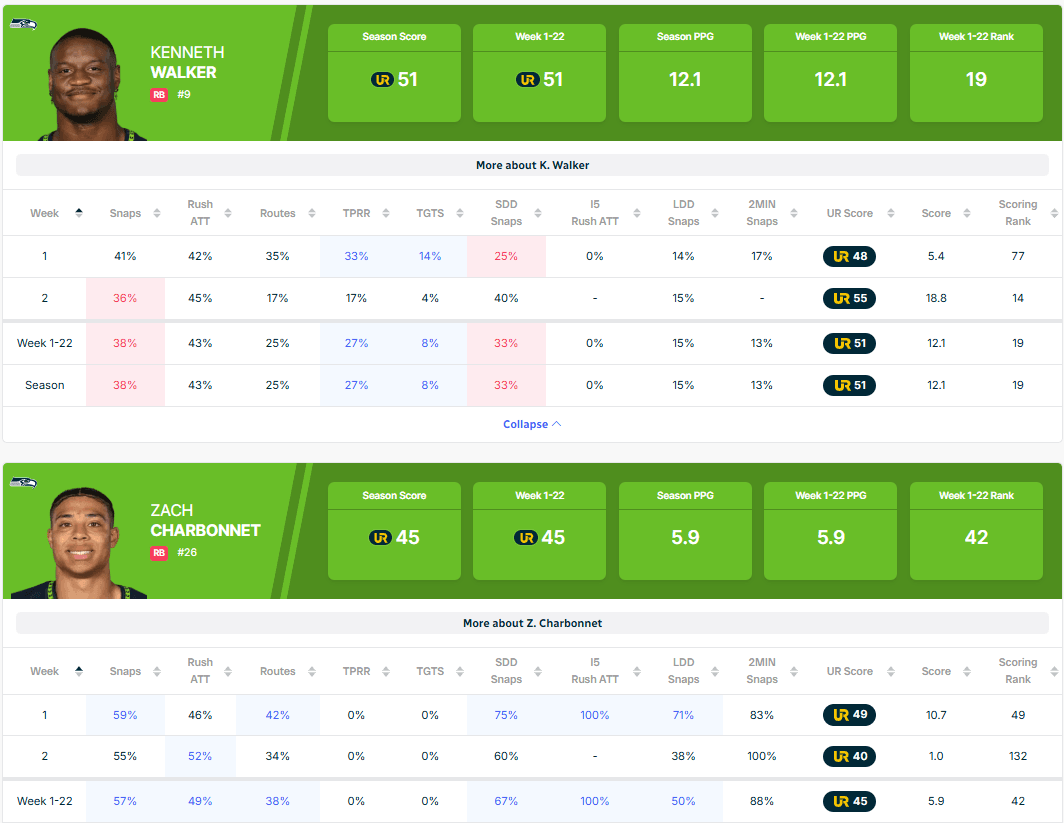
Seahawks: Similar Utilization splits, but Kenneth Walker played great.
Okay. This wasn't a shakeup. It was more of the same on the Utilization front. Walker and Charbonnet were almost in identical roles to Week 1, with Charbonnet acting as the RB1.
However, Walker was the far more productive runner, leading to 18.8 fantasy points. That has Walker's fantasy managers hoping the team makes changes in Week 3. While that is possible, it isn't a lock—based on my research, superior efficiency (playing better) doesn't always unlock more playing time the way we think it would for backs. Of course, Walker has been the lead back before, which might help in this particular instance.
Right now, neither one of these backs is very attractive in fantasy, nuking each other's value.
Utilization Score comparisons:
Kenneth Walker III (51): 9.2 points per game, 53% were RB4s, 25% were RB3s
Zach Charbonnet (45): 8.1 points per game, 56% were RB4s, 10% were RB3s
Not good, y'all! We need this backfield to break free from an even committee approach. Both are borderline RB3s at the moment.
9. Waiver Wire Roundup
Quarterback
Daniel Jones | Colts: Don't look now, but Jones has averaged 26.2 points per game over the first two weeks. He always could win with his legs, but in Shane Steichen's heavy RPO (first) and play-action (5th) scheme, Jones is making strides as a passer. The Colts represent the best weapons ever to surround Jones. Jones is rostered in 18% of leagues but offers the dual-threat upside that makes him worth betting on as a PRIORITY WAIVER WIRE target if you lost Joe Burrow.
Running Back
Blake Corum | Rams: Corum is the clear-cut RB2 behind Kyren Williams. He handled 31% of the snaps in Week 2 and punched in a TD, leading to 10.4 fantasy points. On the one hand, I don't buy Sean McVay's comments around Corum earning a larger role—most of his opportunities came in the fourth quarter in a blowout. On the other hand, Corum could be in for a massive workload should Williams go down. Corum should be rostered in deep formats; he is available in 92% of leagues.
Wide Receiver
Wan'Dale Robinson | Giants: Robinson has always been a target earner, but the downfield strikes weren't a part of his repertoire before the arrival of Russell Wilson. With Wilson, his aDOT is up to 10.7, and Robinson is averaging 19.9 points per game. Robinson UPGRADES to low-end WR3 status and is available in almost 80% of leagues.
Troy Franklin | Broncos: Franklin led the Broncos in route participation (88%), targets (32%), Utilization Score (90), and fantasy points (24) in Week 2. He is distancing himself from Marvin Mims Jr. (41% routes) and Pat Bryant (28% routes) as the WR2 in Denver. The second-year WR has a 72 Utilization Score for the season. Small sample alert: His closest comps since 2020 averaged 14.2 points, with 50% notching a top-24 finish. Franklin UPGRADES to low-end WR3 status and is available in 95% of leagues. He is a HIGH PRIORITY WAIVER WIRE TARGET.
Elic Ayomanor | Titans: Ayomanor made this portion of the column last week, but he is still available in over 90% of leagues. After two games, the rookie ranks second on the Titans in target share (24%) and leads the team with 9.5 fantasy points per contest. Ayomanor is a boom-bust WR4 who could broach the WR3 conversation if Cam Ward gets going.
Tight End
Juwan Johnson | Saints: Johnson has the No. 1 Utilization Score (97) through two weeks, averaging 15.8 points per game. He boasts a 94% route participation, 27% target share, and 30% of his targets have come off of cheat-code play-action looks. Johnson UPGRADES to low-end TE1 status and shouldn't be available in over half of Yahoo leagues.
10. It's a Fugazi!!!
A few players pop up weekly in the fantasy boxscore but lack the underlying goods to back them up. They are best left for the next fantasy manager to worry about.
Donnie Brasco: "You should give it to somebody who doesn't know any better because that's a fugazi."
Kayshon Boutte | Patriots: Boutte made a nice one-handed catch on a drop-in-the-bucket pass from Drake Maye, but the same target-earning issues that have dogged him throughout his career persisted. On an offense that is starving for a playmaker without much target competition, Boutte has a 14% target share—that is not good. His closest Utilization Score comps have finished as a WR4 or worse 66% of the time. They were low-end WR3s 19% of the time. Boutte is a WR4 to WR5.
Utilization Bytes
Quarterback
Russell Wilson | Giants: After a massive 450-yard passing performance against the Cowboys, Wilson is averaging 309 yards and 1.5 TDs per game. While I will take the unders on those for his averages over the rest of the season, Wilson is much more active on the ground through two games. The veteran has averaged 27.5 yards scrambling and six designed rush yards. He ranks eighth in designed rush attempt share (11%) and 13th in scramble rate (8%). Wilson might offer dual-threat upside similar to Drake Maye and Daniel Jones if those numbers hold. Wilson UPGRADES to mid-range QB2 status and is available on most waiver wires.
Running Back
De'Von Achane | Dolphins: Achane ranks fourth in Utilization Score (91), trailing only Christian McCaffrey (25%) in target share at 23%. Achane is a top-six option despite a worrisome Dolphins offense.
James Cook | Bills: Cook has a 79 Utilization Score after two games—well ahead of his score of 66 from 2024. His attempts are up from 52% to 60% year over year. Cook is a low-end RB1.
Jonathan Taylor | Colts: Taylor owns the No. 7 Utilization Score (87) and ranks sixth in fantasy points per game (21.2). His 82% snap share ranks fifth, and the sudden emergence of the Colts as a quality offense unlocks new upside. Daniel Jones could snipe attempts inside the five-yard line, but Taylor is a low-end RB1 with high-end RB1 upside.
Kyle Monangai | Bears: Monangai looks like the RB2 in Chicago. He got extra run in the fourth quarter of a blowout game against the Lions, reaching a 42% snap share. If you are looking for the handcuff in Chicago, Monangai is the best target.
Rhamondre Stevenson | Patriots: Stevenson notched 21.2 points in Week 2 against the Dolphins. He handled 65% of the snaps, 48% of the attempts, and posted a 48% route participation with a 23% target share. It's hard to say how long Stevenson will enjoy the RB1 duties with TreVeyon Henderson waiting in the wings, but for now, the veteran is in the RB3 conversation and offers RB1 upside.
Wide Receiver
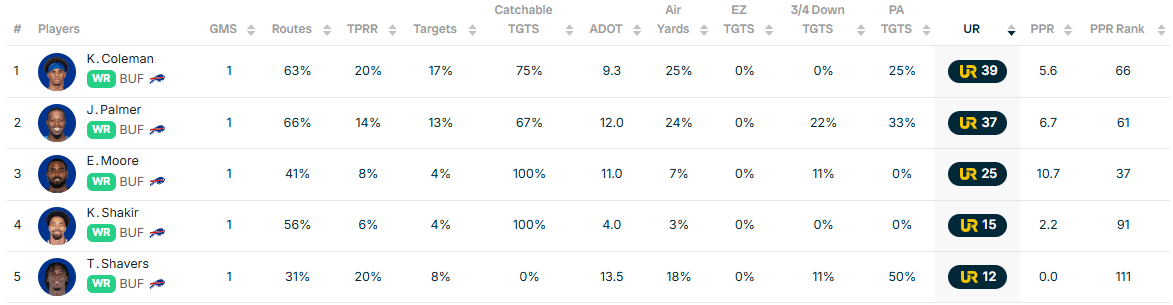
Buffalo WRs | Bills: This coaching staff just does some whack stuff, y'all. After a dormant performance from Keon Coleman in Week 1, no Bills WR reached a 70% route participation rate in Week 2. The entire unit gets a downgrade—it's hard to trust this coaching staff.
Cooper Kupp | Seahawks: Kupp notched a 75 Utilization Score in Week 2 with 16 fantasy points. He notched a 29% target share. The veteran was left for dead by many after a rough Week 1, but the passing game rebounded against the Steelers, and Kupp carved out a role alongside Jaxon Smith-Njigba. Kupp is a borderline WR3.
Davante Adams | Rams: In two games with Matthew Stafford, Adams boasts an 89 Utilization Score—the seventh-highest mark in the NFL. He ranks fifth in target share (34%) and has averaged 15.9 points per game. Adams UPGRADES to low-end WR1 status.
Dyami Brown | Jaguars: Brown is averaging 13.2 fantasy points through two games (WR19), but he is the WR28 in Utilization Score (68). Brown is a nice tertiary player for an offense, but he has never been a strong target earner. Brown is a boom-bust WR4 option.
Hunter Renfrow | Panthers: Renfrow was targeted a whopping four times in the endzone in Week 2, delivering 23.8 fantasy points. His Utilization Score (64) suggests a WR4 until Jalen Coker returns.
Jameson Williams | Lions: After a strong offseason drumbeat around Williams taking his game to a new level, we haven't seen it through two games. Yeah, he came up with a patented long score in Week 2, but Williams has a nasty 14% target share through two games. His Utilization Score (56) is in WR5 territory. Williams remains a boom-bust WR3 for now.
Jauan Jennings | 49ers: Jennings notched 19.9 points in Week 2 against the Saints. He led the team with a 75 Utilization Score as the leading target earner (25%). He was Mac Jones' safety blanket on third and fourth downs, bogarting 42% of the targets. Jennings is the best WR in San Francisco and is a mid-range WR3 in fantasy.
Ricky Pearsall | 49ers: Pearsall has averaged only 12 fantasy points over the last two games despite an injury to George Kittle and Jauan Jennings playing through a shoulder injury. His 67 Utilization Score and 17% target share are disappointing considering the opportunity Pearsall had to show us he is a major target-earning threat. Pearsall DOWNGRADES to borderline WR3 status.
Travis Hunter | Jaguars: Hunter played 39 snaps on defense against the Bengals—up from only six in Week 1. His route participation fell from 82% to 60%. The No. 2 overall pick was still targeted on 22% of his routes, but was unable to get much going with only 5.2 fantasy points. For the season, he ranks No. 1 on the Jaguars with a 26% TPRR. Much of his volume has come under the coverage with a 6.5 aDOT, which has put many into a complete panic. While that might not seem ideal, that is the same range of the field Chris Godwin roamed in this offense in Tampa Bay. It's also in the same range as Puka Nacua, Amon-Ra St. Brown, and Jakobi Meyers. Hunter DOWNGRADES to WR5 status due to playing-time uncertainty, but the aDOT stuff is overblown. Hunter offers significant upside should his playing time improve.
Tyreek Hill | Dolphins: Through two games, Hill has a 69 Utilization Score. He ranks second on the team in target share (21%) behind De'Von Achane. Historical Utilization Score comps graded out more like WR3s and WR4s, which is what we saw from Hill in 2024. Hill DOWNGRADES to high-end WR3 status.
Zay Flowers | Ravens: Flowers has garnered the No. 10 WR Utilization Score (86) through two games, averaging 21.5 fantasy points per game. The Ravens remain a diverse offense that can run or pass, spreading the ball around effectively. Still, through two games, Flowers looks like the clear-cut top option with a 42% target share (second behind Jaxon Smith-Njigba). Flowers UPGRADES to low-end WR2 territory.
Tight End
Colston Loveland | Bears: Through two games, Loveland has a 26 Utilization Score. In Week 2, he was on the field for only 51% of the pass plays while Cole Kmet played 80%. Loveland could come on as the season goes, but for now, he is merely a bench stash option in deeper leagues.
Evan Engram | Broncos: Engram missed part of Week 1 due to a calf injury that might have carried over into Week 2. That makes it difficult to decipher his utilization, but it doesn't look good. His route participation in Week 2 was a lowly 56% as Sean Payton seems happy to rotate all of his skill position players. Engram DOWNGRADES to mid-range TE2 status.
Tyler Warren | Colts: Warren is the No. 3 TE in Utilization Score at 85. The rookie is averaging 13.4 points, and his closest comps averaged 12.6 points per game with 82% securing a top-six season. Warren is locked into top-six status.
Join Our Newsletter
Trusted by 400,000+ fantasy football players. Get access to Fantasy Life's free award winning newsletter and tools, all in one step.



 1. Rome Odunze is breaking out.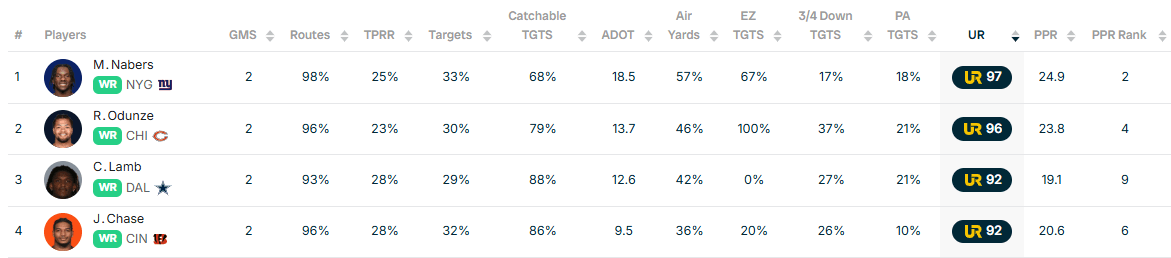
 2. Tucker Kraft is the No. 1 receiver in Green Bay.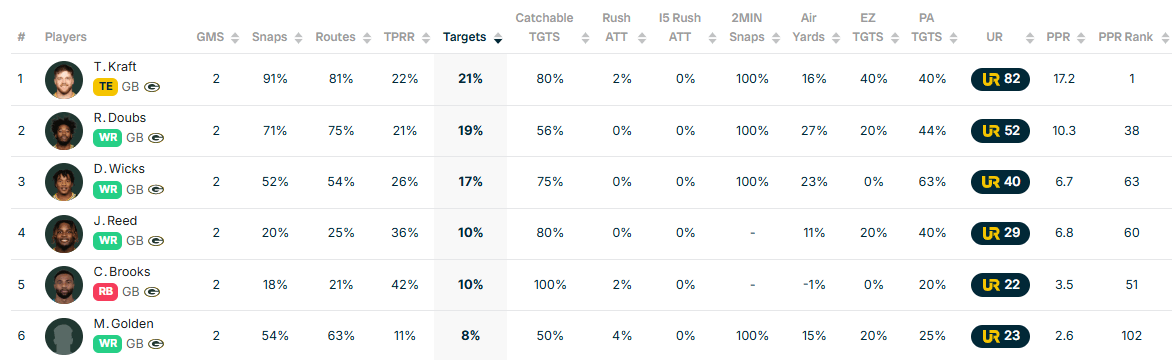
 3. Javonte Williams is running away with the Dallas backfield.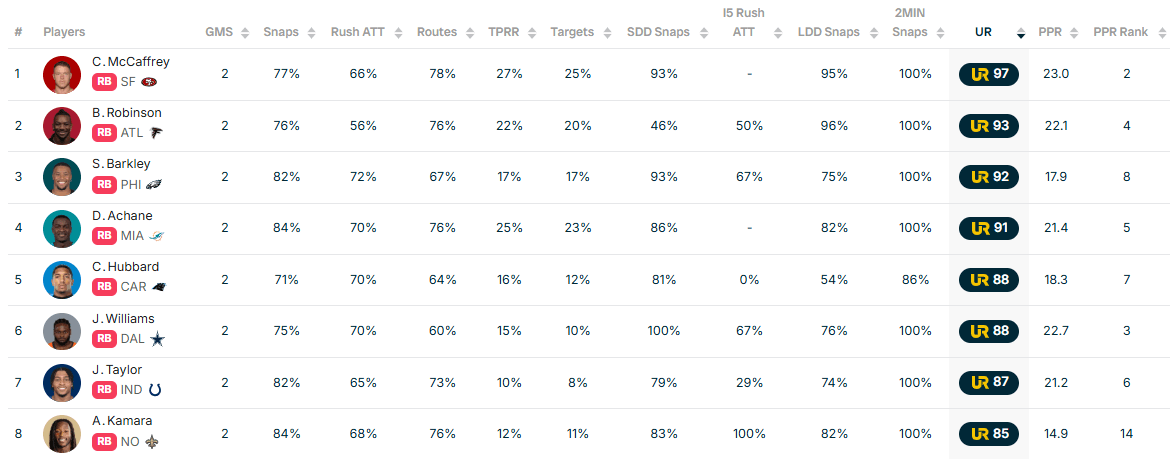
 Brian Thomas Jr. | Jaguars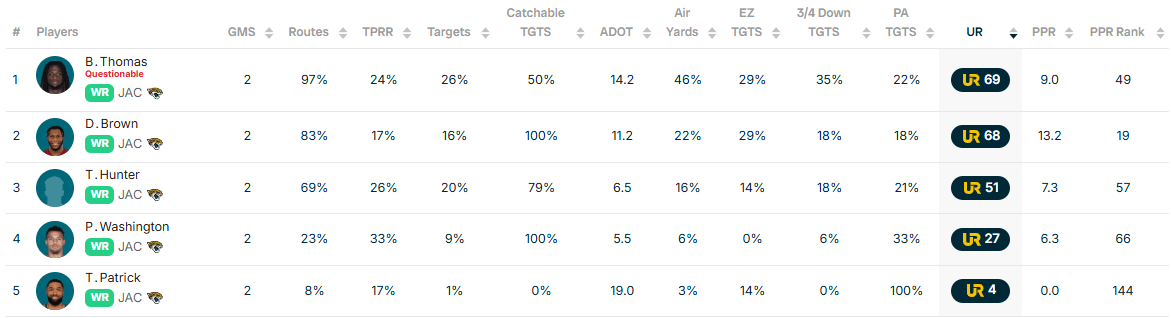

 5. How does the fantasy outlook change for Ja'Marr Chase and Tee Higgins without Joe Burrow?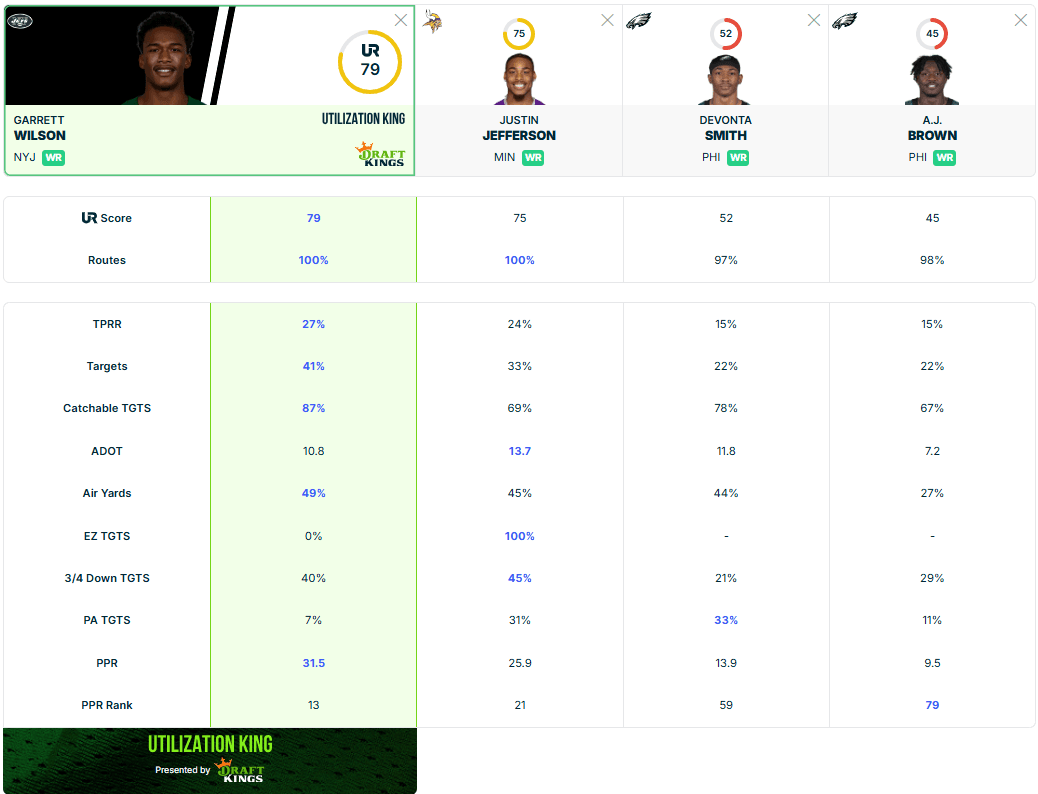


 Giants: A new RB1 in town?
 Cardinals: Turning into a 1A/1B scenario?
 Browns: The return of Quinshon Judkins.

 Seahawks: Similar Utilization splits, but Kenneth Walker played great.