The Utilization Report. Fantasy Takeaways from Week 1.
Dwain McFarland analyzes utilization metrics to determine the most important situations to monitor for Week 2 in fantasy football.
Volume is king in fantasy football, and this report will help you understand which players are due more or less according to their roles. It is a great way to know who is over-performing (sell high) and underperforming (buy low) based on historical data tied to metrics we know drive volume.
- Overall offense: Which teams are enabling winning volume and efficiency across game scripts
- Quarterbacks: How involved is each QB in the running game, and who is unlocking upside for their weapons
- Running backs: Which backs are handling early downs, short yardage, and passing downs
- Tight ends: Who is running enough routes and meeting critical targets per route thresholds
- Receivers: Which receivers are in the most routes and operating broadly within the offense
ICYMI: You can now visualize ALL of our utilization data in one place, thanks to our NEW Utilization Hub.
From game logs and historical stats to team trends, we've put the power of utilization data in your hands. Read on to see the new tool in action…
1. Bijan Robinson is in a committee – DON’T PANIC!!!
Robinson led the Falcons’ backfield with a 65% target share and an eye-popping 82% route participation. Unfortunately, Tyler Allgeier bested him in rushing attempts 58% to 38% and stole all three carries inside the 5-yard line — two of which went for TDs.

Robinson held the lead with nine attempts versus six after three quarters (60%), but Allgeier took over as the closer with nine carries to one in the final frame. The Falcons lead by four-plus points on nine of 15 snaps in the fourth quarter.
If you are a Robinson manager, the 20.3 fantasy points feel great, but part of you knows he could have had a monster day without Allgeier in the fold. While the Falcons’ -20% dropback rate over expectation (DBOE) means the run-heavy attack could support a dual backfield, with Allgeier as the closer, it could limit upside.
All that said, Robinson looked fantastic, and the 38% target share was elite. While Cordarrelle Patterson will rejoin the fold soon, there is a good chance the Falcons figure out ways to get Robinson his 14 to 16 touches every week. If he ever pushes for more, he has RB1 overall upside.
Outlook: Low-end RB1 with RB1 overall upside in more competitive game scripts.
2. Elijah Moore is a great BUY LOW target.
Moore delivered a ho-hum 9.2 fantasy points in his first outing as a Brown. However, his underlying utilization was substantial.

The Bengals didn’t put up much of a fight, allowing Cleveland to rest most of their skill position starters in the fourth quarter outside Deshaun Watson. Once we remove the final quarter of play, Moore’s numbers look even more potent.
- 87% route participation
- 27% target share
- 7% rush attempts
This is a small sample, but those are WR1-worthy numbers, and we have seen Moore flash big-time ability before. Over his final seven games as a rookie, he was a WR1.
Thanks to his subpar Week 1 fantasy points, Moore is the quintessential buy-low candidate. He has strong underlying Week 1 data and a resume that includes high-end fantasy outputs. Over his final seven games as a rookie in 2021, he finished as the WR36, WR26, WR1, WR27, WR3, WR40 and WR8.
Outlook: Mid-range WR3 with WR2 upside.
3. Surprise! Kenneth Gainwell is the Eagles' RB1.
Despite a depth chart listing every Philadelphia resident as co-starters, Gainwell bogarted most of the workload in Week 1 against the Patriots.
The third-year back accounted for 62% of snaps, 61% of rushing attempts and delivered a 14% target share on 42% route participation. Despite playing with a scrambling QB in Jalen Hurts, his targets per route run (TPRR) was stellar at 25%.

Rashaad Penny was a healthy scratch, leaving Gainwell to battle D’Andre Swift and Boston Scott for touches. Swift handled 28% of the snaps but only 4% of the rushing attempts.
Gainwell is currently available in 53% of Yahoo! leagues and is a high-priority add. While this could be a fluid situation, we can’t afford to be shy about an RB with his profile in a quality offense like the Eagles. He could sneak into the RB1 conversation if this utilization sticks.
Don’t be afraid to push over 50% of your FAB dollars into the pot if Gainwell is available in your league. He could be the top fantasy free-agent addition of the 2023 season.
Yes, I can already hear you high-stakes bros laughing and barking, “Not in my league, McFarland.” Well, you got me. But if you have Gainwell, enjoy. Great pick on your part!
Outlook: Mid-range RB2.
Looking to track the utilization of the Eagles' backfield? You can dive into the Week 1 usage and more with the Utilization Hub!
4. Is Puka Nacua for real?
When Nacua was on the field in college, he was electric. His 3.45 career YPRR ranks in the 91st percentile based on PFF data dating back to the 2017 draft class.
However, he was never able to earn a full-time role despite playing at programs without elite talent. His career-high route participation was 61% after removing injury games — which was far below the thresholds of top prospects.
Never earning that full-time role cost Nacua in areas that are important in the Rookie WR Super Model. His career-adjusted yards per team pass attempt were in the 43rd percentile, which is typically bad. Additionally, NFL teams didn’t treat him like a high-end prospect, allowing Nacua to fall to Round 5 of the NFL draft.
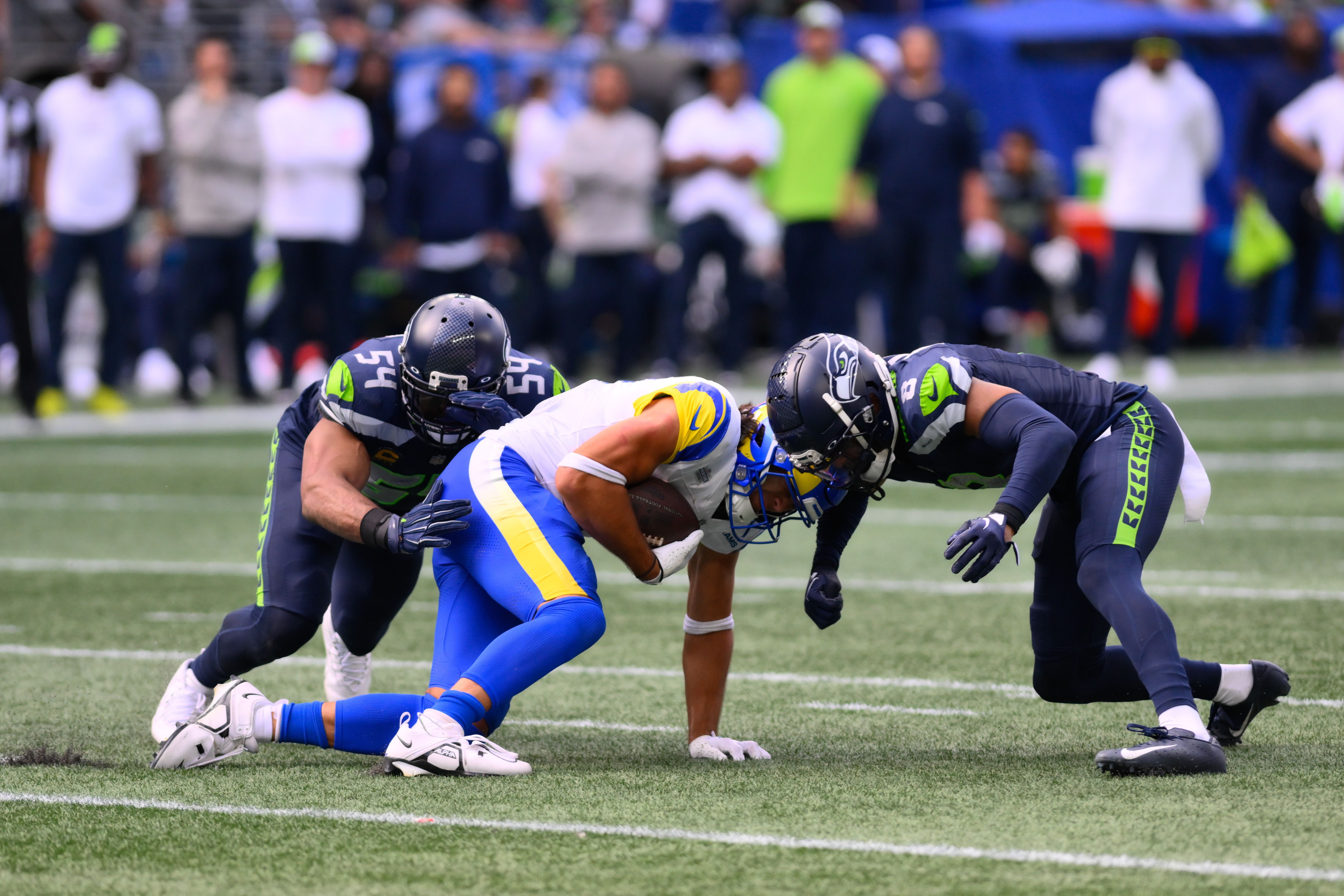
Sep 10, 2023; Seattle, Washington, USA; Seattle Seahawks linebacker Bobby Wagner (54) and cornerback Coby Bryant (8) tackle Los Angeles Rams wide receiver Puka Nacua (17) during the second half at Lumen Field. Mandatory Credit: Steven Bisig-USA TODAY Sports
Simply put, Nacua had one really nice thing about his talent profile, but the majority of indicators were sub-par.
But maybe I need to re-evaluate the process for players who score SO HIGHLY in career YPRR. Here are Nacua’s comps since the 2017 class:
- Corey Davis: 97th percentile
- Taywan Taylor: 96th percentile
- Cooper Kupp: 86th percentile
- Michael Gallup: 99th percentile
- Cedrick Wilson: 96th percentile
- Marquise Brown: 99th percentile
- Darrius Shepherd: 100th percentile
- Tee Higgins: 88th percentile
- Laviska Shenault: 89th percentile
- Jaylen Waddle: 96th percentile
- Cade Johnson: 95th percentile
- Jaxon Smith-Njigba: 86th percentile
Look, this isn’t a surefire list, but there are definitely some notable names. Most went far higher in the NFL draft.
Nacua’s closest overall comps from this group are Taylor, Kupp, Gallup and Shenault, but he scored well below all of them. Only Kupp went on to smash in the NFL, but it is worth noting Sean McVay helped unlock that upside.
Fast-forward to Week 1 of the NFL season. Once again, Nacua came through when given the chance, with a 3.40 YPRR and a sizzling 41% target share on his way to 21.9 points. However, since 1992, we have seen some similar rookie debut performances, most of which have not gone onto fantasy greatness in Year 1.
So, is Nacua for real? I honestly can’t tell you for certain. There are positive and negative data points. However, he has demonstrated a strong rapport with Matthew Stafford and has a skill set that might mesh well with McVay’s scheme.
If you are in need of WR help, I would be very aggressive on Nacua. Yeah, he could flop, but we are early in the season, and if you hit, there is a lot to gain.
Outlook: WR3 with WR2 upside until Cooper Kupp returns.
5. Kyren Williams was a major factor in the Rams backfield.
Williams exploded onto the scene in Week 1, scoring 17.8 fantasy points. The second-year back dominated snaps (67%) and was the primary option in the passing game with a 74% route participation.
He wasn’t targeted heavily but accounted for 86% of the LDD snaps and 100% of the work in the two-minute offense. Williams was a solid target-earning option in college and could have a more significant role in that capacity in the coming weeks.
Cam Akers still led the way on the ground with 56% of the attempts, with Williams handling 38%. However, Willams stole crucial carries in the red zone and scored two TDs.
Williams is available in 94% of Yahoo! leagues and is one of the top priority options after Week 1.
Outlook: RB3 with RB2 spike potential.
6. Jahan Dotson continues to impress.
The second-year WR averaged 23% of the Commanders’ targets over the final five games of 2022 and is picking up where he left off. Dotson posted WR1-worthy data points in Week 1 with a 25% target share and 33% air yards share.

Similar to Elijah Moore, he is another buy-low candidate after finishing as the WR40 with nine fantasy points against the Cardinals.
The former first-round NFL Draft pick will have to battle Terry McLaurin for targets, but if Sam Howell continues to progress, there is room for two solid options in Washington.
Outlook: WR3 with WR2 upside.
7. Rookie Zay Flowers DOMINATED the Ravens' passing attack.
Heading into Week 1, we weren’t sure about Baltimore’s pecking order in the passing game. Historically, the Ravens have rotated their WRs, but with a new coordinator in Todd Monken, we weren’t sure if that would stick.
If the first game is any indication, Flowers and Odell Beckham Jr. are clearly at the top of the depth chart. Flowers was in a route on 93% of the team’s dropbacks and registered a blistering 53% target share.

Many of his targets came underneath the coverage on passes, similar to how the 49ers utilize Deebo Samuel. However, Flowers demonstrated the ability to win at all levels of the field at Boston College. On average, 30% of his targets came 20-plus yards downfield, well above the NCAA average of 17%.
Outlook: Flowers upgrades from WR4 status to a high-end WR3 with room to grow.
8. Calvin Ridley looks like an ALPHA WR1.
For those of you who drafted Ridley in Rounds 3 and 4 of your fantasy drafts, congratulations.
The last time we saw Ridley in a fully healthy season in 2020, he finished as the WR4 overall.
Outlook: Ridley is a top-12 WR with top-six upside.
9. Anthony Richardson is getting MAJOR utilization in the run game.
Richardson accounted for 27% of the Colts' designed rushing attempts and posted a 9% scramble rate.

That sort of utilization puts Richardson in the same category as Jalen Hurts, Justin Fields and Lamar Jackson.
Since 2012, QBs that reached 20% or more of their team’s designed attempts finished as the QB7 overall on average with 23 points per game. Richardson delivered 22 points in Week 1 despite missing the last drive out of precaution due to a lower-body injury.
Coach Shane Steichen indicated Richardson shouldn’t be in danger of missing time.
Outlook: Richardson is a top-10 option, and if his accuracy as a passer holds, he offers top-three upside.
Are you a Richardson believer? You can jump on him to win OROY on BetMGM and get up to $1,500 paid back in bonus bets if your first bet does not win! Simply sign up below and start betting TODAY!

Premium
Get $25 Guillotine League Credits When You Join FL+
Lorem ipsum dolor sit amet, consectetur adipiscing elit. Nunc tinciedunt, ex sit amet cursus gravida, dui mauris vulputate felis.
10. Chris Olave is playing like a WR1.
Olave produced like a WR3 as a rookie, but his comps based on target share and YPRR screamed WR1-upside:
- Ja’Marr Chase
- Justin Jefferson
- A.J. Brown
- Odell Beckham Jr.
- Doug Baldwin
It didn’t take long for the second-year WR to get things going in 2023 with 19.2 points in Week 1 against the Titans.

Olave led the Saints with a 31% target share and 33% air yards share as he and Derek Carr found their groove early. The veteran signal-caller turned to the second-year WR more than any other weapon on third and fourth downs, with a 36% target share.
Outlook: Olave upgrades from high-end WR2 status to a low-end WR1.
11. Kenneth Walker is getting lead-back treatment in Seattle.
This situation could remain fluid given the second-round capital the Seahawks spent on Zach Charbonnet, but Walker was the top option in Week 1.
Walker bogarted 65% of the snaps and 71% of the rushing attempts against the Rams. His 59% route participation and 18% target share might be the most important data points of note. DeeJay Dallas still took the two-minute offense, but Walker remained on the field for much of the LDD work with 43% of the snaps.
We knew the second-year RB was likely to be a large component of the ground attack, but if he continues to see that sort of workload in the passing game, his utilization profile gets a boost.
Since 2012, backs that eclipsed 60% of their team’s attempts and were between 55% and 65% route participation have faired well, averaging 18.5 points. Walker wasn’t a strong target earner in college or as a rookie, but even if we limit the results to RBs with a 12% target share or lower, the average is still 17.1 points.
We don’t know how long Walker will hold onto this sort of workload, but while we have it, he offers RB1 upside.
Outlook: Walker is a mid-range RB2 with low-end RB1 upside for now.
12. Nico Collins continues to stack up positive data points.
The third-year WR made big strides as a target earner last season and kept the accelerator pegged in Week 1. Collins led the Texans in targets (26%) and air yards (64%), leading to 14 fantasy points (WR20).
While many thought the Texans would take a conservative offensive approach with a rookie QB and a defensive-oriented head coach, Houston went the opposite way. They showed trust in C.J. Stroud, with a dropback rate over expectation (DBOE) of 32%.

If Demeco Ryans and staff continue to let Stroud sling the rock, Collins could have more 11-target games in his future.
Outlook: Collins upgrades from the WR4 tier to WR3 status.
13. Tyler Allgeier gets an upgrade but is a sell-high candidate.
Allgeier had a magnificent Week 1 with 24.4 fantasy points thanks to two rushing TDs in the fourth quarter. He handled 82% of the attempts in the final frame and looks like Atlanta’s closer.
In a run-first offense, there is a chance Allgeier continues to outperform his low draft capital, but sustaining his success in close or trailing game scripts could become a challenge. It is worth kicking the tires on trade possibilities with an RB-hungry manager.
Given the Falcons’ QB situation, it is hard to imagine a plethora of leading scripts and high-quality touches over the long term for Allgeier.
Outlook: Mid-range RB3 with RB1 contingent value if Robinson goes down.
14. The Ravens backfield looks murky after the loss of J.K. Dobbins.
Dobbins suffered a season-ending Achilles injury in the third quarter. After the injury, Hill and Edwards split the workload closely.
- Snaps: Hill 41%, Edwards 38%
- Attempts: Hill 41%, Edwards 47%
- Routes: Hill 33%, Edwards 27%
Melvin Gordon will join the group next weekend in what likely shapes up as a three-way committee with Hill or Edwards slightly leading.
Hill and Edwards are viable waiver wire targets, but investing big is hard. Going 10-20% feels like the max given the chance Baltimore could also add a veteran in free agency or via trade.
Outlook: Both RBs profile as low-end RB3s to start, but one could push into the RB2 conversation.
15. Christian McCaffrey gave Elijah Mitchell the stiff arm.
Last season, CMC’s utilization was drastically inhibited in games where Mitchell was active.
- Six games with Mitchell: 35% attempts, 16.7 points per game
- Six games without Mitchell: 59% attempts, 24.9 points per game
If Week 1 is any indication, that trend might be a thing of the past. McCaffrey handled a whopping 69% of rushing attempts and posted an 82% route participation rate on his way to 25.9 points.
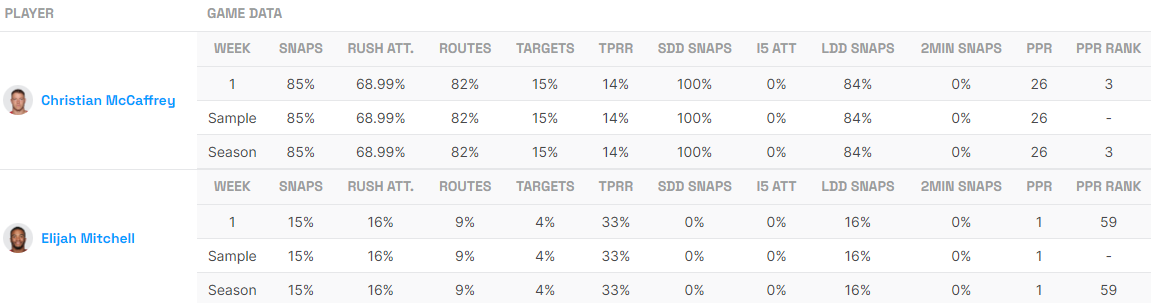
Outlook: McCaffrey once again offers 25-point-per-game upside as the overall RB1.
Utilization Bytes
- Travis Etienne: Accounted for 53% of rushing attempts and posted an 86% route participation with a 16% target share. Tank Bigsby stole a TD from in close, but Etienne’s overall utilization is still strong, and his 21.4 points were good enough for an RB6 finish. Low-end RB1 utilization.
- Nick Chubb: Only played three quarters due to a big lead over the Bengals. Handled 76% of the rushing attempts before the fourth quarter. Didn’t see the expanded route participation we hoped for (35%). Low-end RB1.
- Rachaad White: Didn’t pop in the box score, but the Buccaneers were surprisingly decent on offense, and White played 79% of the snaps. He rarely left the field on passing downs, handling 87% of LDD work and 100% of the two-minute offense. White remains a viable volume play — especially in PPR formats. Low-end RB2.
- Aaron Jones: Was operating as the No. 1 with 70% of the snaps and 73% route participation before the hamstring injury. He looked as spry as ever in the passing attack with a 5.38 YPRR and 25% TPRR. Low-end RB2 with RB1 upside when healthy.
- Javonte Williams: Split the work almost evenly with Samaje Perine in his first game back. He led the team with 62% of the rushing attempts, while Perine was the preferred option in the passing attack with 46% route participation. However, Williams saw a healthy 16% target share. High-end RB3 with RB2 upside.
- Bears Committee: Khalil Herbert led the team in rushing attempts (43%), but all three backs worked across all situations. Roschon Johnson led the way in route participation (37%), but D’Onta Foreman wasn’t far behind at 33%. Situation to avoid until we gain more clarity.
- Jordan Addison: Came through with 16.1 points thanks to 61 yards and a TD but worked behind K.J. Osborn. Addison should eventually push Osborn for the starting role, but his 66% route participation isn’t ideal right now. High-end WR4.
- Jaxon Smith-Njigba: Only registered a 66% route participation but tied for the team lead in targets at 22%. His 26% TPRR was the best on the team. JSN is used to battling high-end talents (Olave, Garrett Wilson, Marvin Harrison Jr.) for targets. His role should expand, and his contingent upside is huge if something happens to DK Metcalf or Tyler Lockett. Remain patient.
- Christian Kirk: Profiled as a WR3-worthy talent heading into the season, and Ridley is taking the meaning of target competition to a new level. That isn’t a great combination for a guy with a route participation under 70% but he should eventually get his as well in an ascending offense in Jacksonville. High-end WR3.
- Quentin Johnston: Playing behind Josh Palmer right now and shouldn’t be in starting lineups after posting a 38% route participation in Week 1. We often see rookies take time to overtake veterans so this is another player that requires patience. Johnston shouldn’t be dropped in most formats — the Chargers offense offers too much upside. Especially if Mike Williams or Keenan Allen misses time. Downgrade: upside WR6.
- Rashod Bateman: Bateman was the odd man out with a 57% route participation in Week 1. He didn’t play in 12 or 21 personnel groupings and the Ravens used 11 personnel on only 45% of snaps, despite Mark Andrews being inactive. Downgrade: upside WR5.
- Marvin Mims: Disappointing 27% route participation despite the Broncos' thin depth chart. Played behind Lil’Jordan Humphrey and Brandon Johnson. Mims doesn’t appear ready and can be dropped in larger formats. We will monitor his playing time as the season progresses. Downgrade: Stash WR6.
- Kendrick Bourne: Led the Patriots with a 93% route participation and 22% target share on his way to 24.4 points. Devante Parker was out, but Bourne worked ahead of JuJu Smith-Schuster and might make some noise with Jakobi Meyers no longer around. The Patriots are notorious for changing up their utilization patterns based on matchups so this could all go away next week, but Bourne has occasionally flashed in the past. Upgrade: WR5
