The Utilization Report. Everything You Need For Fantasy Football In Week 3.
Dwain McFarland analyzes utilization metrics to determine the most important situations to monitor for Week 3 in fantasy football.
Volume is king in fantasy football, and this report will help you understand which players are due more or less according to their roles. Based on historical data tied to metrics we know drive volume, it is a great way to understand who is over-performing (sell high) and underperforming (buy low).
- Overall offense: Which teams are enabling winning volume and efficiency across game scripts
- Quarterbacks: How involved is each QB in the running game, and who is unlocking upside for their weapons
- Running backs: Which backs are handling early downs, short yardage, and passing downs
- Tight ends: Who is running enough routes and meeting critical targets per route run (TPRR) thresholds
- Receivers: Which receivers are in the most routes and operating broadly within the offense
ICYMI: You can now visualize ALL of our utilization data in one place, thanks to our NEW Utilization Hub.
From game logs and historical stats to team trends, we've put the power of utilization data in your hands. Read on to see the new tool in action…
1. The Rams offense is a fantasy friggin goldmine.
There isn’t a bigger story in fantasy than what is happening in Los Angeles. Three players who went undrafted in most fantasy leagues are taking the NFL by storm.
- Puka Nacua is the WR2
- Kyren Williams is the RB2
- Tutu Atwell is the WR15
Bursting onto the scene against the Seahawks was impressive, but delivering big results in Week 2 against the 49ers tells us this team is for real. Yes, teams will adjust to the Rams' attack, but all three players (plus Stafford) deserve significant upgrades in their rest-of-season outlook.
Puka Nacua
Nacua’s 39% target share is the highest in the NFL after two weeks. Over the last 10 years, the WRs who reached a 37% or higher target share over the first two weeks have faired well for the season.
- 2017: DeAndre Hopkins (48%) – WR2 (points per game)
- 2013: Vincent Jackson (45%) – WR17
- 2017: Jarvis Landry (44%) – WR4
- 2018: Julio Jones (42%) – WR4
- 2014: Jordy Nelson (41%) – WR4
- 2013: DeSean Jackson (39%) – WR12
- 2014: Andre Johnson (39%) – WR28
- 2021: Cooper Kupp (38%) – WR1
- 2022: Cooper Kupp (38%) – WR1
- 2018: Michael Thomas (38%) – WR6
- 2021: Deebo Samuel (38%) – WR3
- 2019: Michael Thomas (37%) – WR1
Those are some big-time names, but that is the world we live in, and we must adjust quickly.
Outlook: Nacua UPGRADES to a low-end WR1 until Kupp returns. Upon Kupp’s return, if Nacua is still going strong, he will drop into the WR2 range, and we will reevaluate.
Kyren Williams
Williams had a strong showing in Week 1 with a top-eight finish on 18 points but ceded much of the ground game to Cam Akers, who handled 56% of the attempts.
However, in Week 2, Akers was a healthy scratch, opening the door for a more prominent role for Williams.
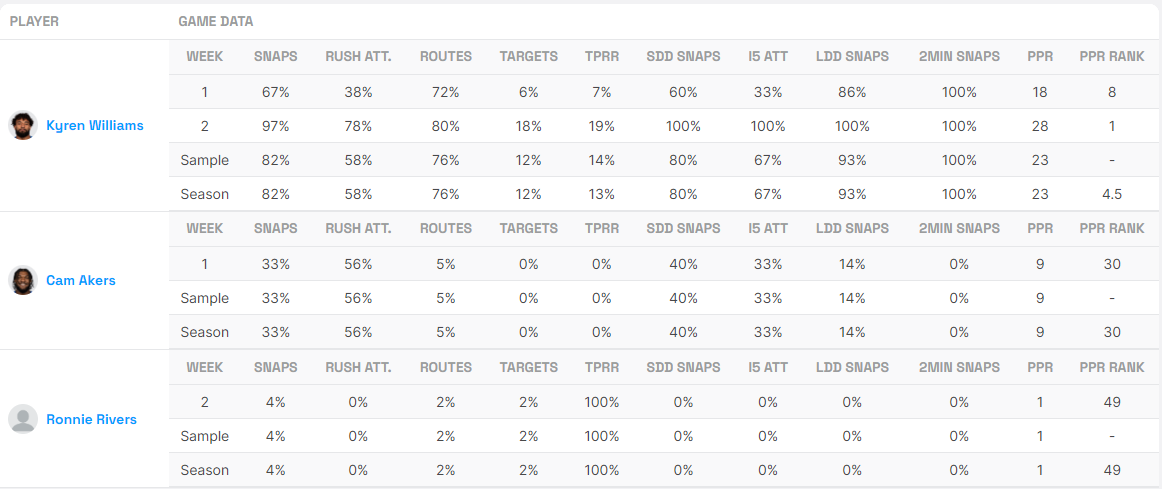
Williams bogarted 78% of the rushing attempts and registered an 80% route participation on his way to an electric 28 points. With Akers on the trade block, we shouldn’t look at Williams’ performances as short-lived — this utilization has staying power.
Since 2012, running backs that handled at least 60% of attempts along with a 65%-plus route participation have SMASHED, averaging 21.9 points per game. The average finish for the group was RB5.
Williams is only 194 pounds, so we could see the team try to work in another back, but the Rams could also lean into the passing game and play to Williams’ strengths in the passing game.
We will slightly temper expectations for now, but the second-year RB is still worthy of a significant move up the rest-of-season ranks.
Outlook: Williams UPGRADES to mid-range RB2 status. He is available in 38% of leagues and should be your No. 1 priority if there. In FAAB leagues, he is worth 90%-plus.
Tutu Atwell
The former Round 2 NFL Draft selection is enjoying a breakout campaign in his third season, but it’s going a little under the radar due to the success of Nacua and Williams. Last season, he showed signs of life at the end of 2022 and is picking up where he left off with a WR3-worthy 19% target share and a WR2-worthy 29% air yards share.
Atwell handles more intermediate and deep route duties (12.9 aDOT), while Nacua patrols the underneath and intermediate zones. When Kupp returns, we could see Atwell displace Van Jefferson as the deep threat.
Outlook: Atwell UPGRADES to a mid-range WR3 until Kupp returns. He will be a WR4 with spike-week upside if he claims Jefferson’s role with Kupp back in the lineup.
Matthew Stafford
Stafford is only rostered in 35% of Yahoo! leagues and is also available in most high-stakes formats. While he hasn’t exploded in the box score yet, the improved weapons provide an upside we didn’t realize existed for the 2023 season.
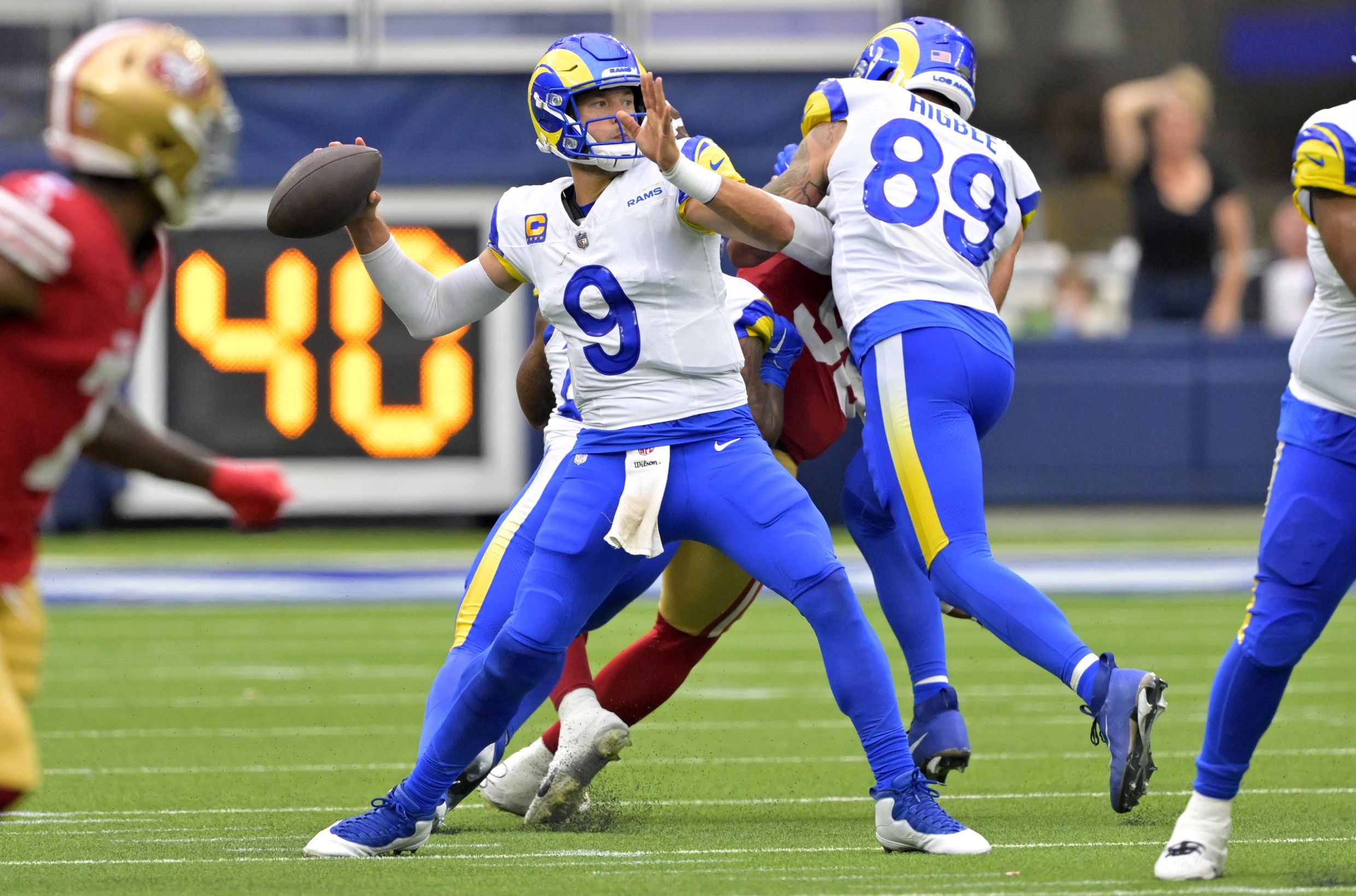
Sep 17, 2023; Inglewood, California, USA; Los Angeles Rams quarterback Matthew Stafford (9) throws a pass in the first half against the San Francisco 49ers at SoFi Stadium. Mandatory Credit: Jayne Kamin-Oncea-USA TODAY Sports
His passing yardage totals of 340 and 307 yards are solid, and the TDs could eventually flow — especially when Kupp returns. With four quality weapons and a shaky defense, Stafford could offer similar upside to Kirk Cousins, who is currently the QB1 in fantasy land.
Stafford was the QB5 overall with 20.4 points per game in 2021 and could make sense for fantasy teams with injured QBs like Joe Burrow and Anthony Richardson.
Outlook: Stafford UPGRADES to mid-range QB2 status and offers QB1 upside.
2. The RB position is RIPE with BUY-LOW opportunities.
A unique combination of events has created an opportunity for fantasy managers in the RB market.
- Multiple high-utilization RBs have busted over the first two games, leaving box-score managers feeling uneasy.
- Multiple late-round and waiver-wire RBs hit in Week 2 (i.e., Brian Robinson, Kyren Williams, Raheem Mostert, Zack Moss), creating a perceived surplus of wealth for some fantasy teams.
Josh Jacobs
Jacobs ranks as the RB26 after delivering 10 or fewer points in his first two games. However, the underlying utilization remains RB1-worthy.

The average finish for RBs over 65% of rushing attempts and between 45 and 55% route participation is RB7 with 18.4 fantasy points per game since 2012.
Additionally, Jacobs is seeing additional love in the passing attack with 21% and 43% TPRRs over the first two weeks in a highly condensed passing tree. Those numbers will regress some, but Jacobs could push for 70 targets.
Outlook: Jacobs still has a top-12 finish squarely in his range of outcomes despite his slow start.
Rhamondre Stevenson
Stevenson handled 73% of the snaps, 61% of the rushing attempts and was in a route on 58% of the dropbacks over the first two games.
Notably, he remains in near sole possession of high-leverage snaps in short-yardage situations (89%) and in the two-minute offense (85%).
His 14.9 points per game (PPG) isn’t bad, but there is room for more. Historically, this utilization profile has offered 18 PPG upside.
Outlook: Stevenson profiles more like a mid-range RB1, making him a value if you can scoop him at an RB2 price.
Joe Mixon
Mixon has the second-highest rush attempt share (79%) and gets all of the Bengals' short-yardage work — including the totes inside the 5-yard line. Over the past two seasons, Mixon was dreadfully inefficient but has shown signs of improvement early.
- Average yards after contact: 3.3 (7th)
- 10-plus yard rush rate: 11.5% (12th)
- Missed tackles forced per attempt: 19% (20th)
- 73.0 PFF rush grade (15th)
Theoretically, this should be an excellent environment for Mixon, but the Burrow calf injury could hamper Cincinnati’s ceiling over the coming weeks.
Outlook: Mixon profiles like a low-end RB1 that should easily best his current 13.5 PPG.
3. Jahmyr Gibbs moves into the high-end RB2 conversation.
David Montgomery is day-to-day with a thigh injury that might keep him out of the next couple of games.
After Montgomery exited Week 2, Gibbs didn’t see a big bump in rushing attempts — with Craig Reynolds scooping up 60% of the totes. However, Gibbs’ route participation skyrocketed to 67%.
This is huge for Gibbs’ outlook in the short term and it could also open the door to secure a larger portion of the passing game reps moving forward. Coaches have always trusted Montgomery in passing downs, but he has never been a special player in that regard.
Alvin Kamara and Christian McCaffrey didn’t reach 30% of the rushing attempts as rookies but still finished as the RB3 and RB9, respectively. How did they do that?
Kamara eclipsed a 50% route participation and posted a 33% TPRR, while CMC reached 79% route participation and a 24% TPRR.
Gibbs currently has a 33% TPRR and if he can up his route participation to 50% or higher, he could perform similarly to what we saw from Kamara in 2017.
Outlook: Gibbs UPGRADES to high-end RB2 status with Monty out. His profile offers mid-range RB1 upside if he capitalizes on the opportunity.
4. Garrett Wilson is a baller but SELLING HIGH is the move.
Wilson is playing like an elite WR over the first two games. His 30% target share is ninth-best in the NFL, and his 47% air-yard share ranks fifth.
However, his environment has deteriorated rapidly. Zach Wilson is the 31st-worst passer according to PFF passing grades, and his 54% completion rate ranks 32nd. Unfortunately, none of these things are new for Wilson — they are extensions of what we have seen over his first two seasons in the NFL.
In Week 2, only 44% of Garrett Wilson’s targets were deemed catchable, and the Jets posted a negative dropback rate over expectation (DBOE) again at -4%. New York is averaging a dreadful 49 plays per game.
Given the Jets' defense and running back depth, it makes sense that they want to take the game out of Wilson’s hands. His 6.7% turnover-worthy play rate is the second-highest in the NFL.
Once we factor in the Jets' dropback volume, even with Wilson at a 30% target share, he looks more like a 115-target player. Historically, WRs with a similar aDOT with 110 to 120 targets finished as low-end WR2s. And we haven’t even considered the reduced catch rate due to Wilson’s accuracy woes.
Wilson will still have some good performances thanks to his route running and big-play ability. However, his reliance on those plays will be higher than ever, making him a boom-bust option. The second-year WR profiles closer to Drake London than the WR1 we had our sights on as a Round 2 pick in our drafts.
If someone in your league still buys into the WR1 hype behind Wilson, now is the time to make your move.
Outlook: Wilson DOWNGRADES to a low-end WR2 who could slip into WR3 territory, given the QB accuracy issues.
5. D’Andre Swift’s talent was on full display in his first start.
Despite never getting the opportunity to play a full-time role in Detroit, the underlying talent signals were there for Swift.
On RB3- to RB4-worthy workloads, he delivered RB2-worthy finishes (15th, 9th and 16th) in PPR formats.
The Lions decided to move on and start fresh with Gibbs, but Swift was a good back in 2022.
- Average yards after contact: 3.1 (14th)
- 10-plus yard rush rate: 13.1% (8th)
- Missed tackles forced per attempt: 24% (7th)
- PFF rush grade: 82.7 (15th)
- Targets per route run: 27% (2nd)
- Yards per route run: 1.65 (4th)
So, really, it is no surprise that Swift exploded for 27 points last Thursday night when given 64% of the rushing attempts and a 55% route participation rate.
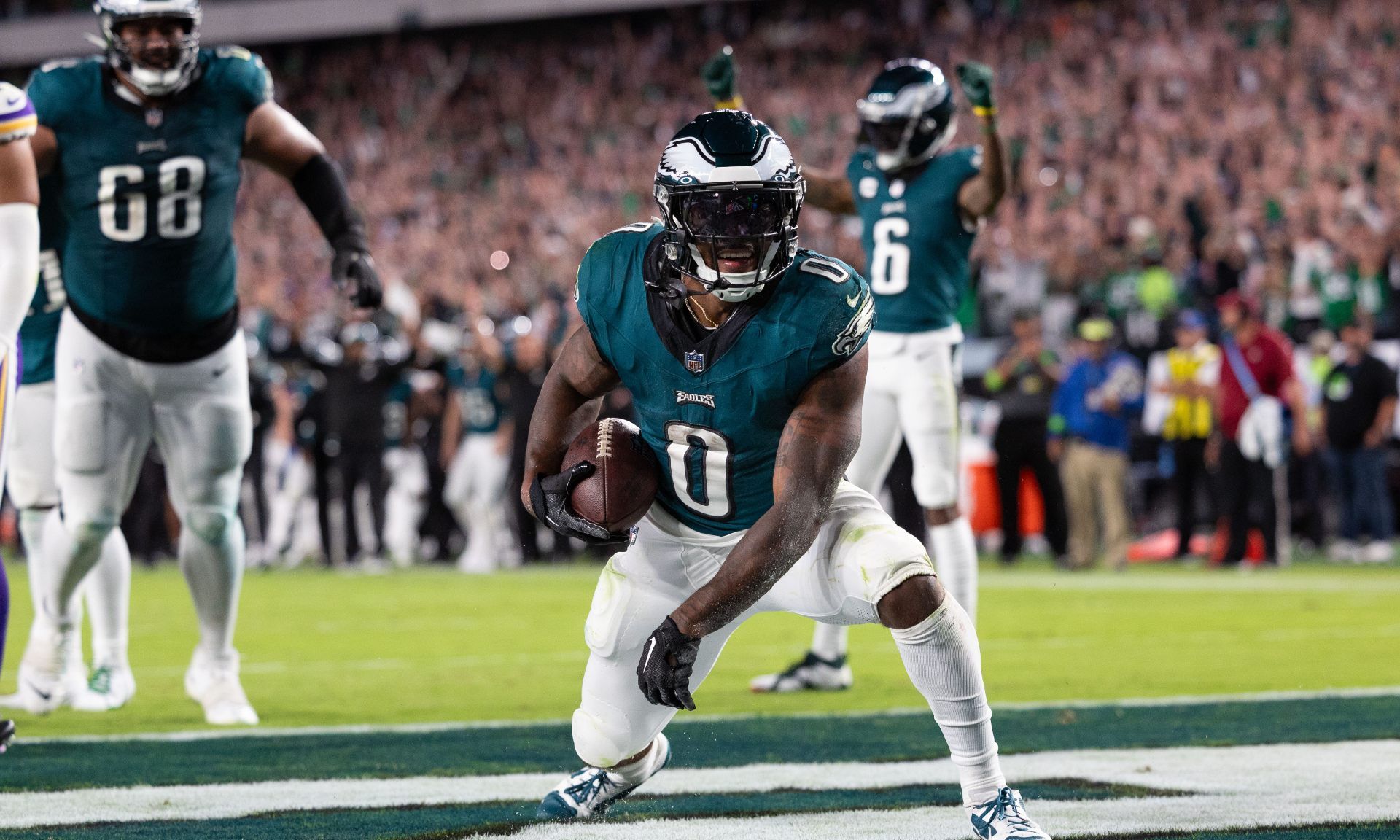
Sep 14, 2023; Philadelphia, Pennsylvania, USA; Philadelphia Eagles running back D'Andre Swift (0) celebrates his touchdown against the Minnesota Vikings during the fourth quarter at Lincoln Financial Field. Mandatory Credit: Bill Streicher-USA TODAY Sports
Swift likely staked a larger claim to the backfield, but the coaching staff already chose Kenneth Gainwell once based on an entire offseason. One thing is clear — the Eagles prefer having a back with passing-down chops as their starter. Rashaad Penny didn’t sniff the field until late in the game when Swift tapped out for a breather.
Outlook: Swift profiles as a boom-bust RB3 option with RB1 upside if the Eagles were impressed enough by his Week 2 performance to crown him as the lead option.
6. Brian Robinson is DOMINATING the ground game in Washington.
Robinson hogged 72% of the rushing attempts in Week 1 and bested that in Week 2 with 86%.
He also took over 100% of the short-yardage work and handled both rushing attempts inside the five-yard line.

Antonio Gibson continues to lead the way on passing downs, averaging 93% of the snaps in the two-minute offense, which could create challenges in the wrong game scripts.
Outlook: Robinson UPGRADES to volume-dependent RB2 territory.
7. Khalil Herbert’s role expanded significantly in Week 2.
D’Onta Foreman was a healthy scratch last weekend, leading the fantasy community to believe Roschon Johnson season was upon us.
However, it was Herbert who soaked up most of the additional work.
- Snaps: Up from 36% to 59%
- Attempts: 43% to 47%
- Routes: 27% to 47%
- Targets: 9% to 12%
- Short yardage snaps: 50% to 100%
While Roschon could still end up as the RB to own later this season, Herbert is the superior option right now.
He hasn’t had much luck in the box score with finishes of RB27 and RB28, but Herbert could make his way back into the RB2 conversation if Chicago can turn their offense around.
Outlook: Herbert UPGRADES to high-end RB3 with upside status.
8. Zack Moss took over the Colts backfield in his return.
Moss bogarted a whopping 98% of snaps, 86% of rushing attempts and tallied a 91% route participation rate. With how poorly Deon Jackson played in Week 1, the door was left open for Moss, and he kicked it in with 21 fantasy points.

We aren’t sure what will happen with Jonathan Taylor, who is eligible to return from the PUP in Week 5, which makes it hard to go all-in on Moss, who is available in 47% of Yahoo! leagues. At a minimum, he is a volume-based low-end RB2.
Of course, there is a chance the Jonathan Taylor situation lingers or the team moves him in a trade, which provides Moss with a small shot at rest-of-season value.
Outlook: UPGRADES to a volume-dependent low-end RB2 until Taylor returns with a small chance for rest-of-season value.
9. I was WRONG about Michael Pittman — he is a target machine.
This preseason I was concerned the Colts could be a run-first offense thanks to Anthony Richardson’s propensity to scramble and a coaching staff looking to protect the rookie with a heavy dose of running plays.
Additionally, the concerns around Richardson’s accuracy made this a situation I wanted to avoid.
I was wrong on all counts.
- Richardson is scrambling, but the Colts dropback rate over expectation (DBOE) is 2% above the NFL average AND the team is operating at a fast pace.
- Pittman’s catchable target rate is 81% and he ranks fifth with 17 catchable looks.
Pittman is rarely leaving the field with a 98% route participation and is commanding targets like an ALPHA with a 33% share. That is elite territory, and his 37% air-yard share is WR1-worthy.
Outlook: Pittman UPGRADES to low-end WR2 territory.
10. Mike Evans and Baker Mayfield are VIBING.
The 30-year-old WR hasn’t delivered a 20% target share since 2019, but he leads the Buccaneers with an eye-popping 28% over the first two games.
Evans’ 47% air-yard share is well above the WR1 threshold of 31% over the past three seasons.
The veteran has WR13 and WR3 finishes over the first two games, and the Bucs' passing attack looks highly consolidated, with almost 50% of targets flowing through Evans and Chris Godwin.
Outlook: Evans UPGRADES to a mid-range WR2 and could force his way higher.
Utilization Bytes:
- Daniel Jones: Jones accounted for 29% and 22% of the designed rushing attempts over the first two games. He added on scramble rates of 16% and 9%. The Giants' offense could be a roller coaster (QB28 and QB1 finishes), but it will be hard for Jones not to finish as a top-12 QB, given his involvement on the ground. Jones Upgrades to a low-end QB1.
- Anthony Richardson: Richardson is the QB9 in fantasy land despite only playing 66% of the Colts’ snaps. He left Week 2 with a concussion. Richardson has high-end QB1 potential when healthy.
- Justin Fields: Fields has QB12 and QB21 finishes but saw an uptick in designed rush utilization at 20% last week. In 2022, it took the Bears a while to integrate the electric runner into the game plan, but once they did in Week 7, he ripped off seven consecutive top-seven finishes. If your local Fields manager is panicking, don’t be afraid to pull the trigger on a trade.
- CJ Stroud: Threw for 384 yards and two TDs in Week 2 in a trailing script versus the Colts. The Texans continue to let their rookie throw the ball, and he is responding. Stroud’s surprise early-season performances are great news for the Texans WR corps. Stroud upgrades to a mid-range QB2.
- Ravens Backfield: Justice Hill and Gus Edwards split the attempts 35% to 32%. Hill saw an edge on passing downs with a 59% route participation. Both backs are RB3 material, with Lamar Jackson vying for rushing work.
- James Cook: Cook saw a slight dip in designed rushing attempts falling from 67% to 49%, but he was more efficient against the Raiders. The second-year back is giving way to Latavius Murray and Damien Harris inside the 10-yard line, but his involvement in the passing game is a big plus. Cook is a mid-range RB2 with RB1 upside if he can steal away just a few of the high-leverage touches in scoring position.
- Samaje Perine: Perine’s snaps held strong in Week 2, but his rushing attempts fell from 38% to 5%. He continues to lead the way in route participation (60%) and operates as the two-minute back (100%). Perine DOWNGRADES to RB4 territory as more of a pure PPR play until we see him regain some of the rushing work.
- Dameon Pierce: It just isn’t happening for Pierce. The Texans' offensive line is in complete shambles, and Pierce’s route participation is at 35% on the season. In an offense falling into trailing scripts, the second-year back is in an uphill battle to find fantasy relevance. Pierce DOWNGRADES to RB3 status for now.
- Isiah Pacheco: The second-year back saw his rushing share increase from 42% to 63% in Week 2. However, Clyde Edwards-Helaire missed multiple practices due to illness last week. If the uptick in rushing attempts sticks, Pacheco could join the low-end RB2 group.
- Raheem Mostert: The veteran RB accounted for 64% of the rushing attempts against New England, and his route participation sits at 65% for the season. Jeff Wilson Jr. is eligible to return as soon as Week 5, but right now, Mostert is the lead back on an explosive Miami attack. Mostert UPGRADES to mid-range RB2 status until Wilson returns.
- Marquise Brown: Joshua Dobbs completed 70% and 68% of his passes over the first two weeks, which puts Brown back on the map in fantasy. Hollywood was a WR1 last season without DeAndre Hopkins, and we are seeing similar target-demanding ability early. In Week 2, he accounted for 36% of the Cardinals’ targets and 34% of the air yards. Brown gets an UPGRADE and rejoins WR3 territory.
- Jerry Jeudy: The oft-injured WR returned to duty in Week 2 with an 86% route participation and a 19% target share. Given the lack of talent and injuries plaguing the Broncos receiving weapons, Jeudy could separate from the pack quickly once he is 100%. Jeudy is a solid BUY-LOW target if you are hurting at WR.
- Marvin Mims: The rookie popped for 20 points to finish as the WR15 in Week 2. Unfortunately, he was only on the field for 14% of the Broncos passing plays. Mims is a talented prospect but doesn’t belong in lineups. He is an upside WR6 stash option in deeper leagues.
- Josh Reynolds: Reynolds has never been a high-end target earner, but he is coming through on big plays in the Lions offense. He has WR28 and WR9 finishes over the first two games. Don’t overbid on Reynolds — the track record for WRs with his profile isn’t kind. He is fill-in material in larger leagues but don’t expect a breakout season.
- Jayden Reed: The rookie WR is balling. He has a 39% TPRR but hasn’t been able to break free from the slot role. The Packers are only using 11 personnel on 55% of their snaps, which is hindering Reed’s upside. However, he has the type of talent profile we want to buy into — a lot can change over the course of the season. Reed is an upside WR5.
- Nico Collins: The third-year WR has target shares of 26% and 21% in his first two games with WR22 and WR5 finishes. With the Texans showing trust in CJ Stroud, Collins has a chance to parlay his strong play into a WR2 finish. For now, Collins UPGRADES to WR3-with-upside territory.
- Tank Dell: Noah Brown probably isn’t getting his job back when he returns. Dell led the team with a 24% target share and was No. 2 behind Robert Woods in route participation at 82%. Dell UPGRADES to a WR4 with upside and is a priority waiver wire target in large leagues.
- Josh Downs: The second-round rookie has reached 77% route participation in back-to-back games. With the Colts' willingness to run an up-tempo offense and the improvements of Richardson in the accuracy department, Downs could surprise in the coming weeks. He is a great WR6 stash play in larger formats.
- Skyy Moore: Moore turned up with a TD that pushed him to a top-30 finish in Week 2. He also saw his route participation increase from 64% to 73%. Unfortunately, the second-year WR still isn’t earning targets. He has marks of 8% and 10% over the first two games. Moore could still break out, but the signals are weak. The best move might be selling this last performance if you have a leaguemate who is crazy for every young WR (every league has one).
- Treylon Burks: Burks saw his route participation dip from 93% to 62%, which isn’t ideal in a run-first offense. Tannehill looked slightly sharper in Week 2, so we don’t want to be rash with a talent profile like Burks. However, right now, Burks shouldn’t be near starting lineups.
- Zach Ertz: The veteran TE has an 85% route participation and a whopping 35% target share. He is currently the TE9 overall, and the improved play of Dobbs gives Ertz some life. Ertz UPGRADES to low-end TE1 status.
- Dalton Kincaid: Kincaid saw his route participation slip to 59% in Week 2 and remains in a rotation with Dawson Knox. The rookie still offers upside, given the undecided nature of the pecking order behind Stefon Diggs in a prolific passing offense. Kincaid is a boom-bust TE2 until we see higher route participation.
- Jake Ferguson: The second-year TE is playing great with a 29% TPRR, but the Cowboys are deploying a committee approach. Ferguson’s 52% route participation is well below what we historically see from TE1s. He is a boom-bust TE2 with upside if his utilization expands.
- Tyler Higbee: The veteran TE continues to see strong route participation (79% and 87%), but the emergence of Nacua and Atwell is a problem. His 10% target share isn’t TE1 material. Higbee DOWNGRADES to high-end TE2 status.
- Gerald Everett: The Chargers are rotating their TEs much more than we saw last season. Everett only registered a 34% route participation in Week 2. Everett DOWNGRADES to low-end TE2 status.
- Hunter Henry: Henry is a top-two TE right now. His route participation was solid in the first two games (72% and 91%), but his 14% TPRR is subpar for a high-end TE. Henry is an UPGRADE as a high-end TE2, but don’t expect him to be a top option.
