2023 Arizona Cardinals Betting Preview
Matthew Freedman dives into the Arizona Cardinals from a betting perspective heading into the 2023 NFL season.
Last year the Arizona Cardinals entered the season fresh off an 11-6 campaign that saw GM Steve Keim, HC Kliff Kingsbury and QB Kyler Murray all get long-term extensions.
Even with the weird “no video game” clause in Murray’s contract, the future of the franchise looked bright — and then the team went 4-13 and lost its final seven games in a season that was plagued by scandal (two offensive position coaches left the team midseason because of incidents of aggression toward women).
The last month of the season was especially painful. On Dec. 14 — two days after Murray was carted off the field in Week 14 with a non-contact ACL tear — he was placed on season-ending IR and Keim took an indefinite leave of absence. And then on Jan. 9 — one day after the season finale, with Murray’s 2023 availability uncertain — Keim resigned and Kingsbury was fired.
And this year might not be any better on the field or off it: In April, owner Michael Bidwell was accused of serious workplace transgressions.
This year — with or without Murray — the Cardinals have one unspoken but indisputable goal: Become the phoenix. Burn it all down… and then rise from the ashes in 2024.
In this 2023 Cardinals preview we will look at the team’s offseason odds in various markets, my personal team projections and player projections for guys who might have props in the season-long markets.
I'll also dive into my projections for the 53-man roster with notes on each unit as well as the general manager and coaching staff, a schedule analysis, best- and worst-case scenarios, in-season betting angles and the offseason market that I think is most exploitable as of writing.
For fantasy analysis, check out Ian Hartitz’s excellent 2023 Cardinals preview.
Player stats from Pro Football Reference and Pro Football Focus unless otherwise noted. Historical sports betting data from Sports Odds History and Action Network (via Bet Labs).
2023 offseason odds
Market | Consensus Odds | Rank | Implied Probability | ||||||||||||||||||||||||||||||||||||||||||||||||||
|---|---|---|---|---|---|---|---|---|---|---|---|---|---|---|---|---|---|---|---|---|---|---|---|---|---|---|---|---|---|---|---|---|---|---|---|---|---|---|---|---|---|---|---|---|---|---|---|---|---|---|---|---|---|
| Intern: | Pro Personnel Intern: | Personnel Assistant: | Pro and College Scouting Assistant: | College Scout: | Area Scout: | National Scout: | Assistant Director of College Scouting: | Director of College Scouting: | Director of Player Personnel: | GM: | DeAndre Hopkins | Michael Wilson | You need to lie | You are good at lying | Quality Control Coach: | College Scout: | Pro Scout: | assistant DBs Coach: | DBs Coach: | DC: | HC: | Lions (Week 1): | Cowboys (Week 16): | Chiefs (Super Bowl): | Terry McLaurin | Jahan Dotson | Curtis Samuel | Kyler Murray | Colt McCoy | Joshua Dobbs | Clayton Tune | Jacoby Brissett | David Blough | James Conner | Keaontay Ingram | Corey Clement | Marquise Brown | Rondale Moore | Michael Wilson | Davante Adams | Michael Wilson: | Davante Adams: | Greg Dortch | Zach Pascal | Zach Ertz | Trey McBride | Geoff Swaim | ||||||
| Rondale Moore | 83.9 | 60.6 | 623.2 | 2.6 | 8.9 | 51.5 | 0.1 | ||||||||||||||||||||||||||||||||||||||||||||||
| Michael Wilson | 65.0 | 37.3 | 427.4 | 1.9 | 0.0 | 0.0 | 0.0 | ||||||||||||||||||||||||||||||||||||||||||||||
| Greg Dortch | 47.7 | 28.9 | 286.8 | 1.3 | 4.6 | 35.7 | 0.0 | ||||||||||||||||||||||||||||||||||||||||||||||
| Zach Pascal | 31.2 | 18.7 | 208.7 | 1.2 | 0.0 | 0.0 | 0.0 | ||||||||||||||||||||||||||||||||||||||||||||||
| Zach Ertz | 65.9 | 40.9 | 394.2 | 3.3 | 0.1 | 0.6 | 0.0 | ||||||||||||||||||||||||||||||||||||||||||||||
| Trey McBride | 53.4 | 38.0 | 385.8 | 2.1 | 0.0 | 0.0 | 0.0 |
Projections as of Aug. 28.
Offensive Line
- Starters: LT D.J. Humphries, LG Elijah Wilkinson, C Hjalte Froholdt, RG Will Hernandez, RT Paris Johnson
- Backups: OT Kelvin Beachum, T/G Dennis Daley, C/G Jon Gaines, OG Marquis Hayes
- Injured: C Pat Elflein (undisclosed)
- Notable Turnover: C Rodney Hudson (free agent), LG Justin Pugh (free agent), C/G Billy Price (Saints), G/C Sean Harlow (Giants), OG Max Garcia (Saints), T/G Josh Jones (Texans) and G/Ts Cody Ford (Bengals) and Rashaad Coward (Texans)
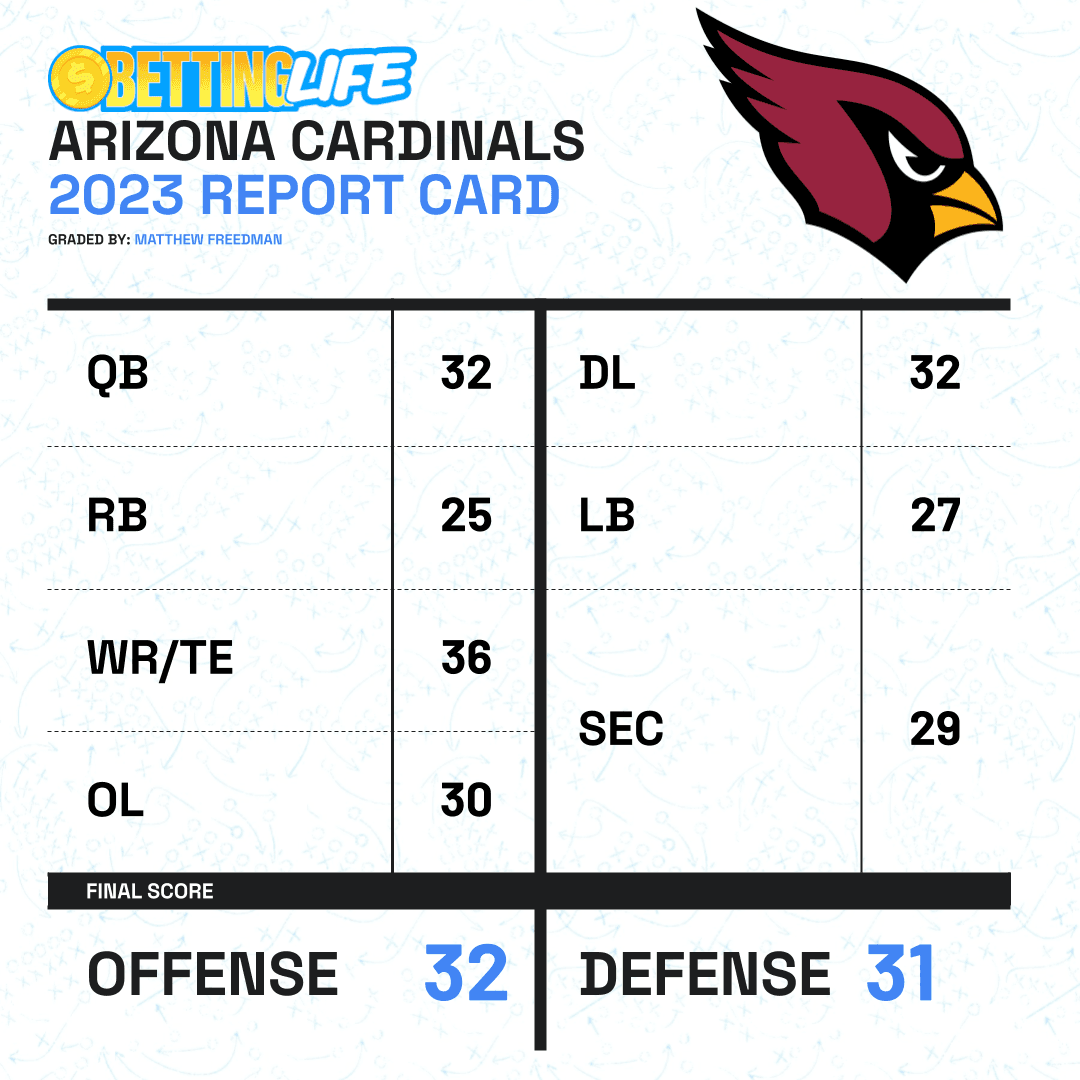
- Unit Ranking: No. 30
Humphries is a 29-year-old franchise blindside protector who has been with the Cardinals since his 2015 rookie campaign. He missed the second half of 2022 but made his first Pro Bowl in 2021 and is still an above-average producer in both phases.
Wilkinson is a 28-year-old utility journeyman now on his fourth team since 2020. Last year with the Falcons — his first at LG — Wilkinson had maybe the best season of his career (64.3 PFF grade on 574 snaps).
Froholdt is a 2019 fourth-rounder who played little in his first two years, but he caught on with the Browns in 2021 and started six games (four at C, two at RG) for them last season before following new OC Drew Petzing to the Cardinals.
Hernandez is a 2018 second-rounder who signed with the team last offseason after four years with the Giants. Although he has a nice 69 career starts, Hernandez is an average-at-best interior player (65.4 PFF grade last year).
Johnson is the No. 6 pick of the 2023 draft. He entered college as a five-star recruit and started 26 games as a sophomore (RG) and junior (LT) before declaring early for the draft. Johnson’s upside is the sky, but he gets by more on traits than technique at this stage, and that might not fly in the NFL.
Beachum is a 34-year-old old hand with 147 starts for his career and 48 starts for the Cardinals since joining the team in 2020. Not since his 2012 rookie year has Beachum had a PFF pass blocking grade lower than 69. The addition of Johnson pushes Beachum to the sideline and makes him one of the league’s best swing tackles, but the start five would likely be stronger with Beachum at his customary RT spot and Johnson inside at one of the OG spots.
Daley is a 27-year-old offseason addition who had a career-best 942 snaps and career-worst 46.1 PFF grade last year with the Titans. He has versatility, but that’s about it.
Gaines is a fourth-round rookie who’s now especially important as a backup with Elflein on IR. Mostly an RG in college, he did get starts at C and RT and has played exclusively at C in the preseason. He’s a better run blocker than pass protector.
Hayes is a four-star 2022 seventh-round project who missed last year on IR but has played plenty in the preseason at both guard spots. His physical talent is unquestioned but also unbacked by fundamentals.
Defensive Line
- EDGE Starters: Zaven Collins, BJ Ojulari
- EDGE Backups: Myjai Sanders, Victor Dimukeje, Cameron Thomas, Dennis Gardeck
- DT Starters: Leki Fotu, Rashard Lawrence
- DT Backups: Jonathan Ledbetter, Kevin Strong, L.J. Collier, Carlos Watkins, Dante Stills
- Notable Turnover: EDGE Markus Golden (Steelers), EDGE/DTs Zach Allen (Broncos) and J.J. Watt (retired), DTs Michael Dogbe (Jaguars)
- Unit Ranking: No. 32
Collins is a 2021 first-round off-ball linebacker who’s shifting to edge this year. As a senior, Collins was a unanimous All-American winner of the Nagurski Trophy and Bednarik and Lombardi Awards, but he has been merely OK (not great) in the NFL, the team needs impact edge defenders after watching Golden, Allen and Watt leave this offseason, and Collins has the physical profile (4.65-second 40-yard dash at 6-foot-5 and 259 pounds) to play the position.
Ojulari is a 21-year-old four-star second-round rookie who started all three years at LSU, where he put up a team-high 12.5 sacks across his sophomore and junior seasons. With his size (6-foot-2 and 248 pounds), he’s more of a pass rusher than run defender.
Sanders is a 2022 third-rounder who was poor as a rookie (53.5 PFF grade) and has missed much of training camp with a minor-ish hand injury, so there’s some beat reporter buzz that he could be cut — but it’s hard to imagine a top-100 pick losing his roster spot after just one year. Dimukeje is a 2021 sixth-rounder with zero sacks on 297 defensive snaps for his career — but he’s a good special teamer.
Thomas is a 2022 third-rounder who flashed as a rookie with 19 pressures on 155 pass rushes. Gardeck is a 2018 UDFA who gets after the QB as a situational edge rusher (eight sacks, 42 pressures on 264 opportunities over the past three years) and stands out on special teams (34 tackles for the Cardinals over the past half decade).
Fotu and Lawrence are both 2020 fourth-rounders. Fotu is yet to have a PFF run defense grade of even 40. Lawrence is solid against the run but has zero career sacks and just nine pressures.
Ledbetter and Strong are both 2019 UDFAs. Ledbetter has played 285 snaps and earned PFF grades of 36.1 and 43.4 since joining the Cardinals two years ago.
Strong is an offseason addition with two starts and one sack in four years.
Collier joins the Cardinals after four disheartening seasons with the Seahawks, who drafted him in Round 1 in 2019, gave him 16 starts in 2020 and then were like “Nah, we’re good” in 2021-22.
Watkins is a 29-year-old veteran who has started 36 games for the Texans (2017-20) and Cowboys (2021-22) over the past six years and given them acceptably league-average backup play.
Stills is a sixth-round rookie who racked up 21.5 sacks and 47.5 tackles for loss in his four years as a core contributor at West Virginia, but he might lack the size ( 6-foot-3 and 286 pounds) to anchor against the run and the athleticism (4.85-second 40-yard dash) to rush the passer in the NFL.
Off-Ball Linebackers
- Starters: Kyzir White, Krys Barnes
- Backups: Owen Pappoe, Josh Woods, Ezekiel Turner
- Notable Turnover: Ben Niemann (Titans) and Tanner Vallejo (Vikings)
- Unit Ranking: No. 26
White is a 2018 fourth-rounder who started his career with the Chargers, played on a one-year “prove it” deal last season with the Eagles and then followed Gannon to the Cardinals. He’s a league-average three-phase backer with just one PFF defense grade below 65.
Barnes is a 2020 UDFA who started 24 games for the Packers over the past three years but was bad in coverage and worse in run defense.
Pappoe is a five-star fifth-round rookie who led Auburn with 91 tackles as a senior and tested well at the combine (4.39-second 40-yard dash), but he might not have the size (6-foot and 225 pounds) to be an every-down player in the NFL.
Woods and Turner are both 2018 UDFA aces. Last year, Woods had a team-high 12 tackles on special teams for the Lions while Turner was No. 2 on the Cardinals in special teams snaps (325) and No. 3 in tackles (five).
Secondary
- CB Starters: Marco Wilson, Kei'Trel Clark, Jalen Thompson
- CB Backups: Antonio Hamilton, Christian Matthew
- S Starters: Budda Baker, Andre Chachere
- S Backup: Jovante Moffatt
- Injured: CBs Garrett Williams (knee) and Rashad Fenton (undisclosed)
- Notable Turnover: CBs Byron Murphy (Vikings), Jace Whittaker (Commanders) and Trayvon Mullen (free agent), CB/S Isaiah Simmons (Giants)
- Unit Ranking: No. 29
Wilson is a 2021 fourth-rounder who has allowed a 66.7% completion rate despite playing primarily on the perimeter. Clark is a sixth-round rookie who — following injuries to Williams and Fenton — seems likely to see significant playing time: He started opposite Wilson in Week 2 of the preseason and then rested with the starters in Week 3. He’s fast (4.42-second 40-yard dash) but undersized (5-foot-10 and 181 pounds) for the perimeter and lacking the technique for the slot.
Thompson is a 2019 fifth-rounder who has started 42 games at safety for the Cardinals and is still listed at safety, but he played primarily at slot corner in Weeks 1-2 of the preseason and is the leading candidate to replace the positionless Simmons, who was just recently traded. An average-at-worst pass defender, Thompson could be the team’s best corner when lined up at nickel.
Hamilton is a 30-year-old veteran who has made seven fill-in starts since joining the Cardinals in 2021. He has inside/outside versatility — he played exclusively in the slot in Week 2 of the preseason — and he didn’t play in Week 3, so he could play in the slot if the team decides to keep Thompson at FS.
Matthew is a 2022 seventh-rounder who had a 48.7 PFF coverage grade as a rookie on 237 snaps.
Baker is a hard-nosed 27-year-old five-time Pro Bowler and two-time first-team All-Pro who has been with the Cardinals since his 2017 rookie campaign. If the team wanted to trade him, it could — but he’s still young enough to be a foundational piece for Gannon’s under-construction unit.
While he can line up across the formation, he’s best in the box on account of his run defense (80.2 PFF grade last year).
Chachere is a 2018 UDFA who was on the Cardinals in 2019 and then with Gannon on the 2020 Colts and 2021-22 Eagles as a depth safety. He’s very much #notgood (32.0 and 35.0 PFF grades over the past two years), but his familiarity with Gannon’s system could give him extended playing time at FS if the team uses Thompson in the slot.
Moffatt is a 2020 UDFA who has played primarily on special teams for the Browns (2020-21) and Falcons (2022) to this point, but the Cardinals have used him as the backup to Baker in the preseason, so he could make the roster and see some regular playing time.
Specialists
- Kicker: Matt Prater
- Punter: Nolan Cooney
- Holder: Nolan Cooney
- Long Snapper: Aaron Brewer
- Kick Returner: Greg Dortch
- Punt Returner: Greg Dortch
- Injured: LS Matt Hembrough (back)
- Notable Turnover: P Andy Lee (free agent)
Prater is a 39-year-old two-time Pro Bowler who joined the Cardinals in 2021. He’s not an overly accurate kicker (83.3% field goal rate for his career, 83.9% over the past two years), but he still has plenty of leg (12-of-16 converting attempts of 50-plus yards with the Cardinals). Cooney is a 2021 UDFA who has never punted in a regular season game.
Brewer is a 33-year-old long snapper who was on the 2013 Broncos with Prater and then joined the Cardinals in 2016. He probably wasn’t going to lose his roster spot to UDFA rookie Hembrough anyway, but he’s safe now with Hembrough on IR.
Dortch has averaged 6.8 yards per punt return and 19.8 yards per kick return in his two seasons with the Cardinals. Last year, the league averages were 8.9 and 22.8.
Schedule analysis
Here are my notes on the Cardinals’ strength of schedule and a pivotal stretch of games that I think will shape how their season unfolds.
- Strength of Schedule: No. 21
- Home Division: NFC West
- Opposing Division: NFC East, AFC North
- Key Stretch: Weeks 4-9
- Opponents: at SF, vs. CIN, at LAR, at SEA, vs. BAL, at CLE
The Cardinals have a harder-than-average schedule with a bye that literally couldn’t be any later (Week 14) and are underdogs in every game. After Week 3, they don’t have any back-to-back home games for the rest of the year, and that’s when the killer stretch starts.
In Weeks 4-9, they have two conjoined three-of-four away stretches (A-H-A-A-H-A). In the two home games, they host the Bengals and Ravens. In the four road games, they play all three divisional opponents and then the Browns in Cleveland, right when the weather is starting to turn cold. In all but one of these games, the Cardinals are underdogs of at least six points.
They could easily go 0-6 in this stretch and even 0-9 to open the year.
2023 worst-case scenario
As a pessimist, I think this is the realistic worst-case scenario for the 2023 Cardinals.
- Owner Michael Bidwell has more serious allegations of workplace misconduct pop up early in the year, and it becomes clear that the league will eventually force him to sell the team. In anticipation of that, Bidwill instructs his GM to focus less on winning later and more on winning immediately.
- GM Monti Ossenfort makes in-season personnel moves — against his better judgment — to maximize the team’s odds of winning games this year.
- HC Jonathan Gannon looks lost as the team starts out 0-9.
- OC Drew Petzing refuses to play rookie QB Clayton Tune because the veteran QBs give the team a better chance to compete each week.
- DC Nick Rallis is relieved of playcalling duties after Week 10.
- QB Joshua Dobbs holds the starting job until the Week 14 bye, after which QB Kyler Murray returns… and then reinjures his knee.
- RB James Conner suffers a high-ankle injury in Week 3 that causes him to miss three games and hinders him until the final month of the season.
- WR Marquise Brown sabotages his potential trade value with a series of unfathomable drops, and WRs Rondale Moore and Michael Wilson are benched following a Week 4 shutout.
- TEs Zach Ertz and Trey McBride battle for playing time, and Ertz overwhelming wins.
- LG Elijah Wilkinson and C Hjalte Froholdt form an exploitable interior duo in their first year with the team, and RT Paris Johnson struggles at a position he has never played.
- EDGE Zaven Collins returns to off-ball LB after he gets zero sacks in the first half of the season.
- The interior DL plays to its talent. In a bad way.
- LB Krys Barnes is benched when Collins returns to LB.
- CBs Marco Wilson and Kei'Trel Clark create the league’s worst perimeter pair.
- SS Budda Baker gets into a sideline yelling match with Gannon in the fourth quarter of a Week 11 road loss to the Texans.
- Cardinals go 4-13 but miss out on the No. 1 pick. The Texans surprise at 7-10, so their first-rounder is outside the top 10. For the sake of continuity, Bidwell wants to keep Gannon, who “proved himself” by going .500 after the team’s 0-9 start. Former HC (and current USC QBs coach) Kliff Kingsbury helps QB Caleb Williams win his second Heisman Trophy, and he goes No. 1 in the draft. QB Drake Maye and WR Marvin Harrison Jr. decide to return to school for their senior seasons because of lucrative NIL deals, and the Cardinals are left with a No. 2 pick that they don’t like and that no other team wants to trade up for.
2023 best-case scenario
As an idealist, I think this is the realistic best-case scenario for the 2023 Cardinals.
- Owner Michael Bidwell publicly defends his GM when asked about the team’s personnel moves: “We’re not tanking. We’re looking to build a team that can compete today and tomorrow and years after that.”
- GM Monti Ossenfort makes a series of in-season moves that maximize that team’s odds of losing this year but winning next year.
- HC Jonathan Gannon spurs the team to a never-ending series of close losses and tells the media after the team’s 0-9 start: “We’re building muscle. We’re biting off more than we can chew — but we’re chewing it, and one of these days we’re gonna learn how to swallow the whole cow with one bite.” The phrase “swallow the whole cow” instantly becomes a social media meme, and some players wear t-shirts with the phrase printed on it in advance of Week 10.
- OC Drew Petzing convinces Gannon to start rookie QB Clayton Tune in Week 1.
- DC Nick Rallis is better at playcalling the defense than Gannon is.
- QB Joshua Dobbs helps Tune develop, and then QB Kyler Murray returns after the Week 14 bye and instantly juices his trade value by leading the Cardinals to a comeback victory at home against the 49ers.
- RB James Conner has his third straight season with 1,000-plus scrimmage yards.
- WR Marquise Brown is traded for a Day 2 pick after Week 3, and WRs Rondale Moore and Michael Wilson both step up to go over 800 yards receiving.
- TE Zach Ertz plays behind TE Trey McBride, who flashes with 500 yards and five touchdowns.
- LG Elijah Wilkinson is benched in Week 4 for Paris Johnson, who immediately dominates in the interior and is replaced at RT by veteran Kelvin Beachum. Meanwhile, C Hjalte Froholdt settles into his new team thanks to his familiarity with Petzing’s system.
- EDGE Zaven Collins breaks out with 10 sacks at his new position.
- The interior DL outplays its talent — but just barely.
- LB Krys Barnes proves that off-ball LBs don’t matter.
- CBs Marco Wilson and Kei'Trel Clark show remarkable resilience in fighting through their early-season struggles to become a feisty (although definitely not feared) duo in the second half.
- SS Budda Baker gets into a sideline yelling match with Texans HC DeMeco Ryans in a Week 11 road win, during which Baker seems to say repeatedly, “We own you.”
- Cardinals go 4-13 and get the No. 2 pick — and the Texans go 3-14, so the Cardinals enter the offseason with the first two selections in the draft. Gannon keeps his job — thanks in part to going .500 after the team’s 0-9 start — and he becomes something of a betting folk hero by covering the spread in all but three games throughout the year. QB Kyler Murray agrees to a trade, and after his excellent 2023 return to form the Cardinals get three first-rounders and two-seconders for him from the rebuilding Raiders. Former HC (and current USC QBs coach) Kliff Kingsbury helps QB Caleb Williams win his second Heisman Trophy, and he goes No. 1 in the draft, followed by WR Marvin Harrison Jr. at No. 2.
In-season angles
I view the Cardinals as a strong “bet against” team. They have a first-time HC, OC and DC. And the HC — whose supposed strength is organizing his side of the ball — is yielding his playcalling power so that he can focus on being a CEO-style leader.
They also have vast uncertainty at the QB position, three new OL starters and a stripped-down defense, especially on the DL and in the secondary..
And based on their GM’s actions they — as a franchise — don’t seem averse to losing.
I think it will take the market some time to adjust to how bad this team is.
Even so, I’ll adjust my prior assumptions quickly if this team looks good (relative to expectations) to start the year. With this much unknowability surrounding a team, flexibility in perspective will be important.
Offseason market to exploit
I don’t even want to look at the team’s futures market. It’s ugly.
If there’s value to be found with this team, it’s probably with a season-long player prop.
Budda Baker Over 99.5 Combined Tackles (-110, DraftKings)
I would normally rather punch myself in the face than bet an over in the season-long market. I’m not a hard puncher, but still.
And yet I love this over for Baker.
He has been extremely durable throughout his career, playing 14-17 games in each year with a median of 15.5. Barring some random injury, he’ll be on the field.
He’s still young at just 27 years old. It’s not as if he’s at risk of wearing down or the team limiting his usage. Given how thin the defense is — and with Jalen Thompson possibly shifting from safety to slot corner — Baker should be on the field as much as possible.
He’s a great player. In his six NFL seasons, he has made the Pro Bowl five times and first-team All-Pro twice.
The Cardinals offense is bad, which means that opposing offenses should have extra possessions against the defense, which in turn means more tackling opportunities.
And the Cardinals defense is bad, which means that opposing offenses should be able to move the ball against them and will likely be inclined to run the ball to grind down the clock — and that means even more tackling opportunities.
And the Cardinals defense — though bad — is designed to prevent big plays, which means that opposing offenses, when moving the ball at ease, will likely progress down the field with extended drives — so… Baker could have a cornucopia of tackling opportunities.
On average, Baker has had 108.3 combined tackles per year with a median of 106.5.
Given the circumstances surrounding him this year, I think this number should be 109.5.
You can tail the over on DraftKings Sportsbook, where you can also get up to $1,000 in DK Dollars when you sign up for a new account below!

Premium
Get $25 Guillotine League Credits When You Join FL+
Lorem ipsum dolor sit amet, consectetur adipiscing elit. Nunc tinciedunt, ex sit amet cursus gravida, dui mauris vulputate felis.