2023 Indianapolis Colts Betting Preview
Matthew Freedman dives into the Indianapolis Colts from a betting perspective heading into the 2023 NFL season.
Last year the Indianapolis Colts entered the season hoping to improve upon their 2021 record of 9-8 and expecting Matt Ryan to upgrade their QB situation.
Hopes dashed, expectations destroyed, the Colts endured a chaos-filled, owner-meddling campaign that witnessed the team start 3-5-1, prematurely fire HC Frank Reich and preposterously hire interim HC Jeff Saturday — a beloved and honored former Colts lineman with no NFL or college coaching experience — who somehow won his first game and then lost every subsequent contest, including an ignominious 39-36 Week 15 overtime defeat in which the fresh-from-the-bye Colts set the all-time record for largest blown lead in NFL history (33-0 at halftime).
Needless to say, Saturday — whom owner Jim Irsay initially wanted to hire as the permanent (not interim) HC — is no longer with the organization. Instead, the team has Shane Steichen, as well as rookie QB Anthony Richardson, a toolsy prospect the Colts selected with the No. 4 overall pick that Saturday gifted them with his string of losses.
This year, the Colts hope to improve upon their 2022 record of 4-12-1 record and expect Richardson to upgrade their QB situation. Sound familiar?
In this 2023 Colts preview, we will look at the team’s offseason odds in various markets, my personal team projections and player projections for guys who might have props in the season-long markets.
I'll also dive into my projections for the 53-man roster with notes on each unit as well as the general manager and coaching staff, a schedule analysis, best- and worst-case scenarios, in-season betting angles and the offseason market that I think is most exploitable as of writing.
For fantasy analysis, check out Ian Hartitz’s excellent 2023 Colts preview.
Player stats from Pro Football Reference and Pro Football Focus unless otherwise noted. Historical sports betting data from Sports Odds History and Action Network (via Bet Labs).
2023 offseason odds
Market | Consensus Odds | Rank | Implied Probability | ||||||||||||||||||||||||||||||||||||||
|---|---|---|---|---|---|---|---|---|---|---|---|---|---|---|---|---|---|---|---|---|---|---|---|---|---|---|---|---|---|---|---|---|---|---|---|---|---|---|---|---|---|
| Quenton Nelson | Shaquille Leonard | Jonathan Taylor | Andrew Luck | Jacoby Brissett | Matt Ryan | Justin Herbert | Jalen Hurts | Peyton Manning | Matthew Stafford | Jalen Hurts | Trevor Lawrence | Kyler Murray | Saquon Barkley | Jonathan Taylor | Brock Purdy | David Montgomery | Breece Hall | Allen Lazard | Shaquille Leonard | Anthony Richardson | Josh Allen | Gardner Minshew | Jalen Hurts | Jonathan Taylor | Zack Moss | Nyheim Hines | Evan Hull | Deon Jackson | Michael Pittman | Alec Pierce | Josh Downs | Isaiah McKenzie | Tavon Austin | Breshad Perriman | Mike Strachan | Ashton Dulin | James Washington | Kylen Granson | Jelani Woods | Mo Alie-Cox | Will Mallory |
| Alec Pierce | 70.9 | 38.9 | 565.9 | 2.6 | 0.0 | 0.0 | 0.0 | ||||||||||||||||||||||||||||||||||
| Josh Downs | 48.9 | 31.8 | 387.1 | 1.9 | 0.0 | 0.0 | 0.0 | ||||||||||||||||||||||||||||||||||
| Isaiah McKenzie | 36.4 | 20.3 | 207.6 | 1.2 | 5.2 | 32.9 | 0.1 | ||||||||||||||||||||||||||||||||||
| Jelani Woods | 49.9 | 31.5 | 398.4 | 3.1 | 0.0 | 0.0 | 0.0 | ||||||||||||||||||||||||||||||||||
| Mo Alie-Cox | 18.7 | 11.3 | 134.7 | 1.6 | 0.0 | 0.0 | 0.0 | ||||||||||||||||||||||||||||||||||
| Kylen Granson | 16.9 | 12.8 | 137.9 | 0.7 | 0.3 | 1.2 | 0.0 |
Projections as of Aug. 20.
Offensive Line
- Starters: LT Bernhard Raimann, LG Quenton Nelson, C Ryan Kelly, RG Will Fries, RT Braden Smith
- Backups: OT Blake Freeland, G/T Dan Skipper, C/G Danny Pinter, OG Emil Ekiyor
- Injured: OT Jake Witt
- Notable Turnover: T/G Matt Pryor (49ers) and OT Dennis Kelly (Eagles)
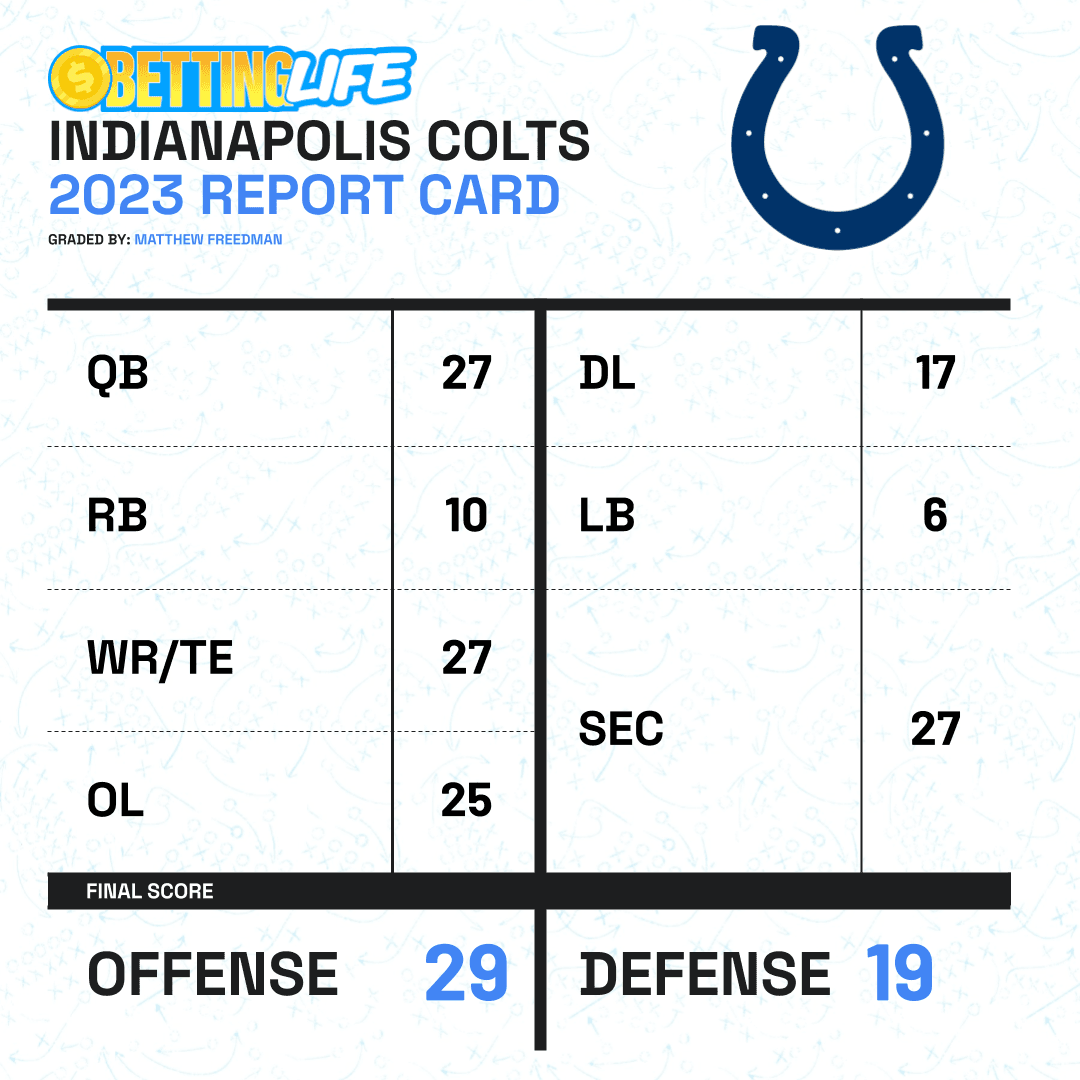
- Unit Ranking: No. 26
Raimann is a 2022 third-rounder who anchors an OL that has a wide range of outcomes, was less than the sum of its parts last year and didn’t make any personnel upgrades this offseason. As a rookie, he started 11 games and showed promise (73.3 PFF grade), but he also allowed too many sacks (seven).
Nelson is a 2018 first-rounder who has made the Pro Bowl every season. He’s a potential Hall of Famer — but last year he had a career-high five sacks, a career-worst 68.4 PFF grade and a career-first absence on the league’s All-Pro first and second teams. There’s a chance that he is now merely good instead of great.
Kelly is a 2016 first-rounder who has started every year for the Colts since his rookie season and who made the Pro Bowl in each of the 2019-21 campaigns — but not in 2022. Last year, Kelly — like Nelson — allowed a career-high five sacks.
Fries is the clear weak link in the OL chain. A 2021 seventh-rounder, he has PFF grades of 54.8 and 58.4 over the past two years. Smith is a 2018 second-rounder whose high floor buckled a little bit last season under the weight of… you guessed it… a career-high seven sacks.
Freeland is a fourth-round rookie with elite traits (4.98-second 40-yard dash at 6-foot-8 and 302 pounds), four years of starting experience and LT/RT versatility, but he’s more of a high-effort backup than potential future starter.
Skipper is a 2017 UDFA who joins the Colts after playing a career-high 387 snaps last year for the Lions and having a career-worst 43.9 PFF grade. Pinter is a 2020 fifth-rounder who allowed nine pressures and three sacks in his four games as a primary lineman last season.
Ekiyor is a rookie UDFA who has an amplified chance of making the roster since Witt (seventh-round rookie) suffered a season-ending hip injury in training camp. A four-star three-year RG starter at Alabama, Ekiyor lacks range as a blocker but has the technique and consistency to develop into an NFL contributor.
Defensive Line
- EDGE Starters: Kwity Paye, Samson Ebukam
- EDGE Backups: Tyquan Lewis, Dayo Odeyingbo, Titus Leo
- DT Starters: DeForest Buckner, Grover Stewart
- DT Backups: Taven Bryan, Eric Johnson, Adetomiwa Adebawore
- Injured: EDGE Genard Avery (knee)
- Notable Turnover: EDGEs Yannick Ngakoue (Bears), Ifeadi Odenigbo (Jets) and Ben Banogu (Cowboys), DT Byron Cowart (Texans)
- Unit Ranking: No. 22
Paye is a 2021 first-rounder who has an OK-ish 10 sacks in his first two years but is yet to translate his elite athleticism (4.57-second 40-yard dash at 6-foot-4 and 272 pounds) into commensurate production. Ebukam is a high-floor/low-ceiling 28-year-old veteran who joins the Colts this season after six years with the Rams (2017-20) and 49ers (2021-22). He has 4.5-5 sacks in each of his four most recent seasons.
Lewis is a 2018 second-rounder who missed the second half of last season with a ruptured patellar tendon, but he played in Week 2 of the preseason and should be healthy to start the year. In five years, Lewis has 9.5 sacks.
Odeyingbo is a 2021 second-rounder who is decent against the run (65.5 PFF grade last year) thanks to his tweener size (6-foot-6 and 286 pounds), but he’s forgettable as a pass rusher. Leo is a small-school sixth-round rookie who racked up 32.5 tackles for loss in his final two seasons despite his smaller size (6-foot-4 and 245 pounds).
Buckner is a 29-year-old two-time Pro Bowler who has been with the Colts ever since they traded the 49ers a first-rounder to get him in the offseason before his 2020 first-team All-Pro campaign.
Good in run defense and strong in pass rush (44 sacks over the past five years), Buckner is the muscle of the Colts DL. Stewart is a 2017 fourth-rounder who has started for the Colts since 2019. He has minimal impact as a rusher but has never had a PFF run defense grade below 65.
Bryan is a 2018 first-round reclamation project who joins the Colts after five seasons with the Jaguars (2018-21) and Browns (2022). While the first two seasons of his career were promising, Bryan hasn’t had a PFF grade over 60 since 2020.
Johnson is a 2022 fifth-rounder who got three tackles and no sacks as a rookie on 127 snaps. Adebawore is a fourth-round rookie with the ability to line up inside because of his size (6-foot-2 and 282 pounds) and outside because of his unreal athleticism (4.49-second 40-yard dash). He has the potential to develop into an interior pass-rushing terror.
Off-Ball Linebackers
- Starters: Shaquille Leonard, Zaire Franklin
- Backups: E.J. Speed, JoJo Domann, Grant Stuard
- Notable Turnover: Bobby Okereke (Giants)
- Unit Ranking: No. 5
Leonard is a 2018 second-rounder who won Defensive Rookie of the Year and then made three Pro Bowl in 2019-21 before missing almost all of 2022 because of various injuries (back, concussion, nose). Strong in all phases, Leonard is one of the best off-ball LBs in the league when healthy — and he was healthy enough to play in Week 1 of the preseason.
Franklin is a 2018 seventh-rounder who stepped into a full-time role last year because of Leonard’s injury and significantly underwhelmed (57.0 PFF grade), especially in coverage.
The departure of Okereke means that Franklin will once again be a starter, and there’s some hope that he can enjoy positive regression, given that he played well in previous seasons (albeit in limited action), especially against the run, where he has never had a PFF grade lower than 60.
Speed, Domann and Stuard all played 250-plus snaps on special teams last year and are core contributors in that phase. Additionally, Speed (2019 fifth-rounder) earned a career-high 316 defensive snaps last year and did well (78.4 PFF grade). Domann (2022 UDFA) and Stuard (2021 seventh-rounder) are aces who have combined for 25 special teams tackles in their three collective seasons.
Secondary
- CB Starters: Kenny Moore, Dallis Flowers, Darrell Baker
- CB Backups: Julius Brents, Darius Rush, Tony Brown
- S Starters: Julian Blackmon, Rodney Thomas
- S Backups: Nick Cross, Henry Black
- Injured: S Daniel Scott (knee)
- Borderline: CB Jaylon Jones, SS Ronnie Harrison and FS Trevor Denbow
- Notable Turnover: CBs Stephon Gilmore (Cowboys), Isaiah Rodgers (free agent) and Brandon Facyson (Raiders), SS Rodney McLeod (Browns)
- Unit Ranking: No. 31
Moore is a 2017 UDFA who is the ostensible No. 1 CB now that Gilmore (traded) and Rodgers (suspended then released) are gone. The problem with that is he’s a slot-limited defender who made the Pro Bowl in 2021 and then had the worst season of his career in 2022 (46.3 PFF coverage grade).
Flowers is a 2022 UDFA who played just 175 snaps last year and allowed 9.4 yards per target. Baker is a 2022 UDFA who saw action last year on only 31 special teams snaps but has emerged as a training camp standout, started opposite Flowers in Weeks 1-2 of the preseason and appeared at the top of the team’s unofficial depth chart ahead of its second preseason game. He looks like a perimeter starter.
Brents is a second-round rookie with elite size (6-foot-3 and 198 pounds), great agility (6.63-second three-cone), sufficient speed (4.53-second 40-yard dash), the length to become competent in press-man coverage and the skills to contribute in a zone scheme — but the fact that he’s not certain to start in Week 1 on this depth chart is concerning.
Rush is a fifth-round rookie who — like Brents — is a physical specimen (4.36-second 40-yard dash at 6-foot-2 and 198 pounds). A WR-to-CB convert in college, Rush is a raw upside-heavy project.
Brown is a 28-year-old journeyman who has experience with DC Gus Bradley and DBs coach Ron Milus (2018 Chargers, 2021 Raiders, 2022 Colts). He played just 10 snaps last year on defense but 302 snaps on special teams.
Jones is a 21-year-old five-star seventh-round rookie who started three years in the SEC at Texas A&M but had just three interceptions and 12 passes defended in that span. He’s talented but fighting for a roster spot.
Blackmon is a 2020 third-rounder who bangs against the run (low PFF grade of 75.8 in each of his three seasons) but collapses in coverage (high PFF grade of 57.4). With the departure of McLeod, Blackmon is likely to shift to SS from FS, where Thomas will now play as the second starter. A 2022 seventh-rounder, Thomas notably underperformed as a rookie (54.3 PFF grade).
Cross is a 2022 third-round box safety who looked lost against the run and in coverage on 122 snaps last year. Black is a 2020 UDFA who spent last year on the Colts practice squad after playing minimally and poorly for the Packers in his first two seasons.
With Scott (fifth-round rookie) out for the year after suffering an ACL tear in OTAs, both Harrison and Denbow have a shot to make the team. Harrison is a 2018 third-rounder who signed with the team in mid-August.
A classic box safety (6-foot-3 and 214 pounds) who largely disappointed in his first five seasons with the Jaguars (2018-19) and Browns (2020-22), Harrison forced a fumble and had five tackles in the second preseason game (his first with the team) but also gave up 30 yards on two targets.
Denbow is a 2022 UDFA who has started both preseason games, which seems to make him likely to make the team, but he played zero defensive snaps last year.
Specialists
- Kicker: Matt Gay
- Punter: Rigoberto Sanchez
- Holder: Rigoberto Sanchez
- Long Snapper: Luke Rhodes
- Kick Returner: Dallis Flowers
- Punt Returner: Isaiah McKenzie
- Notable Turnover: K Chase McLaughlin (Buccaneers), P Matt Haack (Cardinals)
Gay is a 2019 fifth-rounder who underwhelmed as a rookie with the Buccaneers (77.1% conversion rate), improved as a second-year player with the Rams (87.5%) and then dominated for L.A. in his third and fourth seasons (93.8%, 2021 Pro Bowl, 11-of-14 kicking on attempts of 50-plus yards). His four-year deal with $13M guaranteed ensures that he’ll make the Colts in his first season with the team.
Sanchez has been the No. 1 P with the Colts since his 2017 rookie season, but he missed last year with a torn Achilles. There’s nothing exceptional about his career marks of 45.1 yards per punt and 38.5% punts downed inside the 20-yard line.
Rhodes has been long snapping for the Colts since his 2016 rookie campaign. A 2020 second-team All-Pro and 2021 first-team All-Pro and Pro Bowler, Rhodes — I guess — is good at hurling a ball between his legs with accuracy and velocity.
Flowers had a league-high 31.1 yards per kick return last year, although it’s possible — now that he’s expected to start at corner — that he could offload some return duties to McKenzie, who averaged 22.6 yards per kick return and 9.2 yards per punt return over the past five years with the Bills.
Schedule analysis
Here are my notes on the Colts’ strength of schedule and a pivotal stretch of games that I think will shape how their season unfolds.
- Strength of Schedule: No. 4
- Home Division: AFC South
- Opposing Division: AFC North, NFC South
- Key Stretch: Weeks 13-16
- Opponents: at TEN, at CIN, vs. PIT, at ATL
The Colts have one of the league’s easiest schedules. Based on the market win totals of their opponents, they have the No. 4 schedule. On top of that, they have nine home games, and one of their away games is a neutral contest in Frankfurt.
As a rookie, Richardson could struggle early in the year, but the schedule is kindly situated to give the Colts two home games to close the year against the Raiders and Texans. If they finish strong, the Colts could make the playoffs. But their stretch of games in Week 13-16 — before the closing homestand — is tough.
After the Week 11 bye, the Colts as favorites host the Buccaneers. Nothing especially challenging there, but then they play three-of-four away and are underdogs in each game. In Week 13, they have a road divisional rematch against the Titans followed by another road game against the Bengals.
In Week 15, they return home to host the Steelers, who have three extra days of rest, and then the Colts hit the road again to play the Falcons.
If the Colts are to make a late-season push to the playoffs, they’ll need to win at least two of these games.
2023 worst-case scenario
As a pessimist, I think this is the realistic worst-case scenario for the 2023 Colts.
- Owner Jim Irsay fires GM Chris Ballard midseason and assumes the position of acting GM after Irsay orders Ballard to give RB Jonathan Taylor a lucrative contract extension and Ballard refuses.
- HC Shane Steichen comes under intense media and fan scrutiny after starting the season 0-10 and barely escapes from the Week 11 bye with his job.
- OC Jim Bob Cooter is sacrificially terminated in the bye week as Steichen assumes full control of the offense.
- DC Gus Bradley coordinates a bottom-five defense.
- QB Anthony Richardson looks like a 21-year-old rookie who started only one year in college and struggled with his accuracy.
- RB Jonathan Taylor gets his above-market contract extension, suffers a slight knee tweak in Week 7 and decides to sit out until the Week 11 bye — just to stick it to the man retroactively — even though he’s medically cleared to play in Week 9.
- WR Michael Pittman is traded by Irsay to the Chiefs for a second-round pick after Pittman’s agent tells the Colts that his client intends not to sign a long-term with the team.
- The OL crumbles for a second consecutive season.
- EDGEs Kwity Paye and Samson Ebukam fail to give any meaningful pass-rushing support to DT DeForest Buckner, who openly questions the team’s leadership and future after the team’s last-minute loss to the Patriots in Germany in Week 10.
- LB Shaquille Leonard reinjures his back in Week 5, tries to return to action after the Week 11 bye but is unable to do so, and consequently announces his retirement in Week 15.
- CBs Dallis Flowers and Darrell Baker are both benched in Week 3 but reinserted into the starting lineup in Week 6 when their replacements perform unacceptably.
- Colts finish 5-12, fail to secure a top-three pick in the draft and are unsure about the viability of Richardson as an NFL QB entering his second season. Irsay states in his end-of-year press conference that he plans to retain Steichen, who showed great promise by going 5-2 to close the year — but then he fires Steichen two weeks later, shortly after which he announces that the team has hired its new GM — Peyton Manning, who plans to bring back Jim Caldwell and Jim Bob Cooter as HC and OC.
2023 best-case scenario
As an idealist, I think this is the realistic best-case scenario for the 2023 Colts.
- Owner Jim Irsay announces after Week 1 that he plans to take an extended break from social media and team operations in order to enjoy life more.
- HC Shane Steichen works his magic and wins Coach of the Year.
- OC Jim Bob Cooter helps Steichen construct an offense that maximizes the talent of their rookie passer.
- DC Gus Bradley coordinates the No. 12 defense.
- QB Anthony Richardson wins Offensive Rookie of the Year and sets the single-season rushing record for a QB with 1,300 yards.
- RB Jonathan Taylor reports to training camp shortly before the season starts, gets a small raise, stays healthy and has his second first-team All-Pro campaign with 2,000-plus yards from scrimmage.
- WR Michael Pittman has the most efficient season of his career with 9.5 yards per target.
- The OL returns to its pre-2022 form.
- EDGEs Kwity Paye and Samson Ebukam combine for 15 sacks in support of DT DeForest Buckner, who gets a career-high 13.5 sacks and his second first-team All-Pro designation.
- LB Shaquille Leonard plays 16 games and finishes No. 2 in the league with 175 tackles.
- CBs Dallis Flowers and Darrell Baker get the job done in Bradley’s Cover 3 scheme.
- Colts go 12-5, win the AFC South, beat the Chargers on Super Wild Card Weekend and then hang with the Chiefs for three quarters before losing by 13 points in Kansas City in the Divisional Round.
In-season angles
I view the Colts as a neutral betting team.
I think it’s notable that ever since DC Gus Bradley returned to the coordinator ranks (after his Jaguars HC stint) and teamed up with LBs Coach Richard Smith and DBs Coach Ron Milus in 2017, unders have been the winning side for his three teams.
- 2022 Colts Unders: 10-7 (13.1% ROI)
- 2021 Raiders Unders: 10-8 (6.8% ROI)
- 2017-21 Chargers Unders: 38-28 (11.9% ROI)
Also, I expect Richardson to offer some profitable opportunities throughout the year. He will likely be rough, but the betting history of first-round rookie running QBs is good. (Note: I’m arbitrarily saying that a guy qualifies for this sample if he has 75-plus rushing attempts as a rookie.)
- Vince Young (2006): 10-3 ATS (52.2% ROI)
- Cam Newton (2011): 9-7 ATS (11.6% ROI)
- Robert Griffin (2012): 10-5 ATS (30.5% ROI)
- Josh Allen (2018): 6-5 ATS (4.6% ROI)
- Lamar Jackson (2018): 4-3 ATS (13.0% ROI)
- Kyler Murray (2019): 9-5-2 ATS (22.7% ROI)
I’ll be picking my spots with the Colts.
Data from Action Network, regular season only.
Offseason market to exploit
We have a low-hold market on the Colts win total.
- Over 6.5: -120 (Caesars)
- Under 6.5: +110 (DraftKings)
Since the sportsbooks have only a 2.22% edge in this market, we have a larger margin for error than we usually do, so this is theoretically a good spot to take a shot.
Plus, I have the Colts projected for 7.2 wins, thanks in part to their easy schedule.
But if you’ve been reading my team previews then you know that I loath overs in the win total market, which tends to be inflated. And I also want a bigger payout than this market typically affords.
So if I’m bullish on the Colts relative to their win total, I should probably look to bet them in a market that offers more upside.
There’s no chance that the Colts win the Super Bowl or the AFC, so those markets are out. But what about the AFC South? They’re +700 at Caesars to win their division.
But here’s the thing, if the Colts win the AFC South, then I think one member of the team is likely to offer a much bigger upside in the awards market.
Shane Steichen to Win 2023 Coach of the Year (+2500, FanDuel)
If the Colts win their division, then they will almost certainly have at least nine wins. Probably closer to 10-11 wins, and maybe even 12 wins — just one season after going 4-12-1 and having the No. 4 overall pick.
With that kind of year-over-year improvement in the win column, Steichen will be live to win Coach of the Year, especially because he’ll likely carry narrative threads that Associated Press voters can neatly tie together.
Steichen is a first-year coach, so he has the appeal of novelty, and writers can talk about him as if he’s a young ascending talent with the long-term potential to change the game. They can talk about his work in guiding Richardson to a winning record as a rookie and helping him — just as he previously helped Herbert and Hurts — develop into an NFL QB. And they can draw parallels to the past, when first-year HC Bruce Arians received the award after winning 11 games and mentoring Luck as a rookie after the franchise lost Manning.
And here’s the thing: I actually think Steichen will be a good coach.
He has the ability to develop Richardson. And he has the potential to win double-digit games in 2023.
If that happens, Steichen will be a frontrunner for the award.
You can tail the 25-1 longshot on FanDuel Sportsbook, where you can take advantage of their No Sweat First Bet and get up to $1,000 paid back in bonus bets if your first bet does not win.
Sign up below to start betting today!

Premium
Get $25 Guillotine League Credits When You Join FL+
Lorem ipsum dolor sit amet, consectetur adipiscing elit. Nunc tinciedunt, ex sit amet cursus gravida, dui mauris vulputate felis.
