2023 Tampa Bay Buccaneers Betting Preview
Matthew Freedman dives into the Tampa Bay Buccaneers from a betting perspective heading into the 2023 NFL season.
Last year the Tampa Bay Buccaneers entered the season hoping to replicate the playoff success of their 2020 championship run and build upon the regular-season triumph of their 2021 13-win campaign.
But with pseudo-retired QB Tom Brady and without fully retired HC Bruce Arians, the Buccaneers stumbled to a losing 8-9 record and yet somehow won their division only to lose by more than two touchdowns to the Cowboys on Super Wild Card Weekend.
And now Brady is retired. Again. To pick up his mantle, the Buccaneers have tapped QB Baker Mayfield, presumably because they couldn’t reach Johnny Manziel.
A verified journeyman with his recent travels, Mayfield is like a lottery in that if he doesn’t work out some people in the town are gonna get stoned. Killed. Not high. But maybe both. If there’s enough time. (Shout out all you Shirley Jackson stans.)
This year, the Buccaneers hope to maintain their defense, improve on offense, win for a third straight season an exploitable NFC South and — just maybe — discover that all Mayfield required to become a franchise QB was a change of scenery and circumstances. Again. What they need to do, however, is embrace the pleasure of pain.
In this 2023 Buccaneers preview, we will look at the team’s offseason odds in various markets, my personal team projections and player projections for guys who might have props in the season-long markets.
I'll also dive into my projections for the 53-man roster with notes on each unit as well as the general manager and coaching staff, a schedule analysis, best- and worst-case scenarios, in-season betting angles and the offseason market that I think is most exploitable as of writing.
For fantasy analysis, check out Ian Hartitz’s excellent 2023 Buccaneers preview.
Player stats from Pro Football Reference and Pro Football Focus unless otherwise noted. Historical sports betting data from Sports Odds History and Action Network (via Bet Labs).
2023 offseason odds
Market | Consensus Odds | Rank | Implied Probability | ||||||||||||||||||||||||||||||||||||
|---|---|---|---|---|---|---|---|---|---|---|---|---|---|---|---|---|---|---|---|---|---|---|---|---|---|---|---|---|---|---|---|---|---|---|---|---|---|---|---|
| Mike Evans | Jameis Winston | Vernon Hargreaves | O.J. Howard | Tom Brady | Tyler Lockett | Russell Wilson | Geno Smith | Without question, Canales excelled in Seattle in every role he had. | Napoleon Kaufman | Tyrone Wheatley | Charlie Garner | LaMont Jordan | Felix Jones | DeMarco Murray | Matt Forte’ | Todd Gurley | Ezekiel Elliott | Tony Pollard | Rachaad White | Baker Mayfield | Deshaun Watson | Matthew Stafford | Kyle Trask | John Wolford | Rachaad White | Leonard Fournette | Chase Edmonds | Ke'Shawn Vaughn | Sean Tucker | Mike Evans | Chris Godwin | Trey Palmer | Russell Gage | Deven Thompkins | Rakim Jarrett | Cade Otton | Ko Kieft | Payne Durham | |
| Chris Godwin | 122.4 | 78.9 | 864.3 | 4.2 | 1.8 | 10.6 | 0.0 | ||||||||||||||||||||||||||||||||
| Trey Palmer | 63.1 | 34.9 | 436.5 | 1.9 | 0.0 | 0.0 | 0.0 | ||||||||||||||||||||||||||||||||
| Cade Otton | 60.3 | 38.1 | 393.9 | 3.2 | 0.0 | 0.0 | 0.0 |
Projections as of Aug. 24.
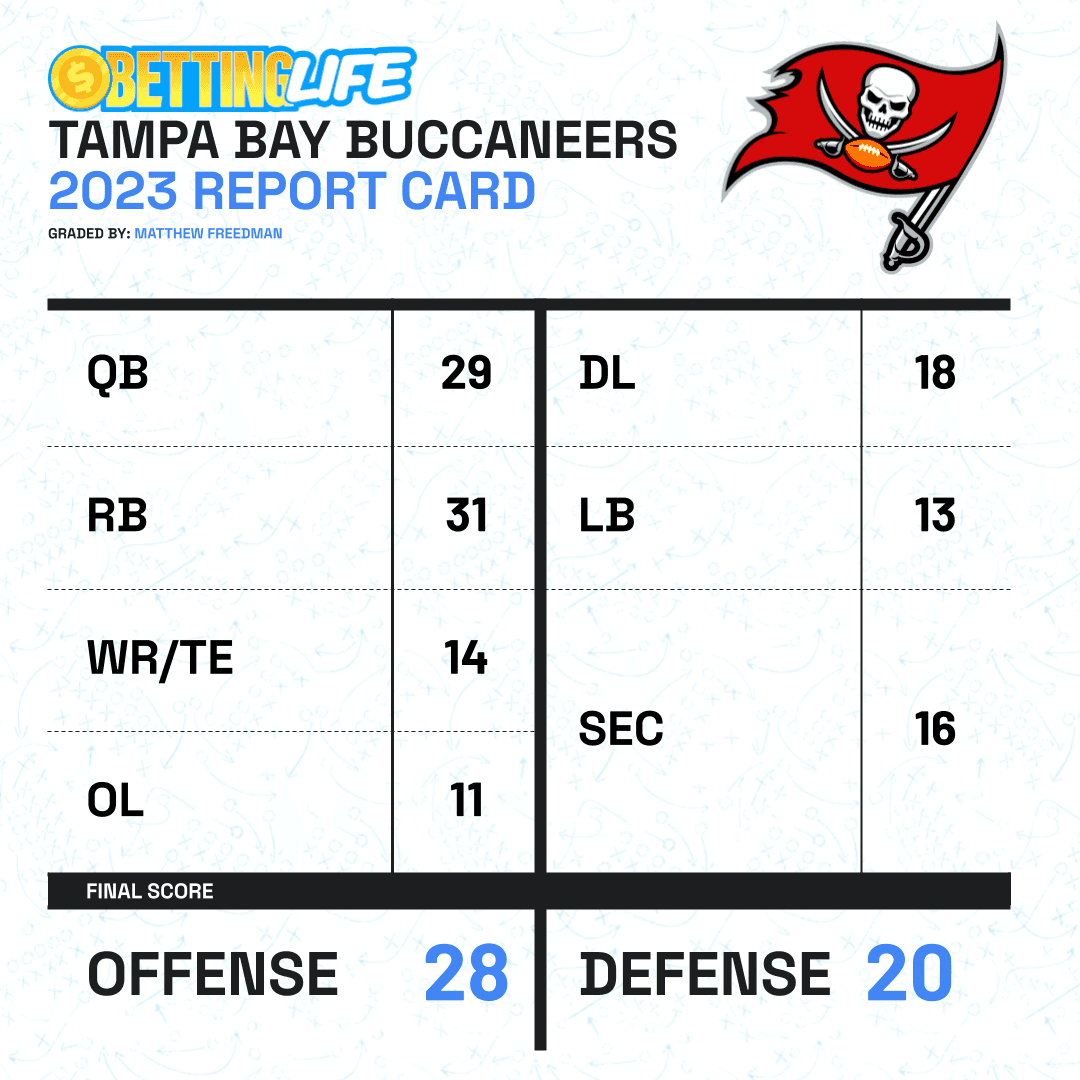
Offensive Line
- Starters: LT Tristan Wirfs, LG Matt Feiler, C Ryan Jensen, RG Cody Mauch, RT Luke Goedeke
- Backups: OL Robert Hainsey, T/G Justin Skule, G/C Nick Leverett, OG Aaron Stinnie,
- Borderline: T/G Brandon Walton
- Notable Turnover: LT Donovan Smith (Chiefs), OT Josh Wells (Jaguars) & RG Shaq Mason (Texans)
- Unit Ranking: No. 16
Wirfs is a 2020 first-rounder with freaky athleticism (4.85-second 40-yard dash at 6-foot-5 and 320 pounds) who started three years at Iowa primarily at RT and has played every game of his NFL career at RT but now is tasked with transitioning to the blindside. A 2021 first-team All-Pro with two Pro Bowls, Wirfs is likely to be a good long-term LT, but he could struggle early.
Feiler is a 31-year-old offseason addition who has a good track record (no PFF grade below 65 in the 2017-21 timeframe) but is coming off a career-worst season in which he allowed six sacks and 40 pressures for the Chargers.
Jensen is a 32-year-old veteran who joined the team in 2018 and made the Pro Bowl in 2021 but suffered an ACL tear last preseason that sidelined him until the team’s Wild Card game, in which he allowed a dreadful six pressures. Jensen continues to rehab his knee this offseason and is yet to practice, so he’s far from certain to start in Week 1 — in fact, he seems likely not to at this point — and he’s not even a lock to play at all this year.
Mauch is a 24-year-old second-round rookie who converted from TE to OT (39 starts) at FCS champion North Dakota State and is now transitioning to guard in the NFL. A butt-kicking, teeth-missing mauler of a man, Mauch is rugged but ready to add some muscle to this OL. Goedeke is a 2022 second-rounder who — like Mauch — moved from TE to OT in college.
He was terrible last year — especially in pass protection — in his seven starts at LG, but he was playing out of position, and he improved as the season progressed: In his final two starts (including playoffs), he allowed just two pressures on 102 pass rushes. Shifting back to his natural RT position, he could be significantly better this year.
Hainsey is a 2021 third-rounder who started 34 games at RT at Notre Dame, entered the draft as a guard-flexible prospect and then played 17 games at C in place of the injured Jensen last year — and he did well as the pivot, allowing zero sacks all year. If Jensen is unable to play, Hainesy will be ready to start.
Skule played with the starters in Week 1 of the preseason, so I give him the edge for now as the team’s swing tackle. A 2019 sixth-rounder who has played just 16 snaps over the past two years, Skule struggled in 12 starts with the 2019-20 49ers (30.4 and 45.1 PFF pass blocking grades).
Leverett is a 2020 UDFA who made 10 fill-in starts last year (nine at LG, 1 at C), and he handled himself well, allowing just 12 pressures and no sacks. If Mauch or Feiler suffers an injury or underperforms, Leverett might be able to step in with minimal disruption. Stinnie is a 2018 UDFA who made three playoff starts for the Buccaneers in their Super Bowl but has played just 102 snaps since then. He has never had a PFF grade of even 60.
Walton started Week 2 of the preseason and is likely competing with Skule for the swing tackle role. A 2020 UDFA, he made two LT starts last year and allowed just one sacks on 145 pass rushes. Walton looks like the superior player to Skule, and he was ahead of him on the depth chart last year, but it’s a little concerning that he hasn’t played ahead of Skule this preseason.
Defensive Line
- EDGE Starters: Shaquil Barrett, Joe Tryon-Shoyinka
- EDGE Backups: Anthony Nelson, YaYa Diaby, Jose Ramirez
- DT Starters: Vita Vea, Calijah Kancey
- DT Backups: Greg Gaines, Logan Hall, William Gholston, Patrick O’Connor
- Notable Turnover: EDGE Carl Nassib (free agent), DTs Rakeem Nunez-Roches (Giants) & Akiem Hicks (free agent)
- Unit Ranking: No. 17
Barrett is a 30-year-old veteran who missed the second half of last year with an Achilles tear but has 40.5 sacks and two Pro Bowls since joining the team in 2019. A strong two-phase player, Barrett has never had a PFF grade below 67.5. Tryon-Shoyinka is a 2021 first-rounder with eight sacks just eight sacks in two years, but he took a step forward in his second season and will be an above-average contributor if he makes similar progress this season.
Nelson is a 2019 fourth-rounder who has gotten increasingly worse in run defense (88.5 PFF grade as a rookie, 61.1 last year) as his snap total has sequentially grown each year (152 as a rookie, 692 last year). As a pass rusher, he’s solid yet unexceptional with 10.5 sacks over the past two seasons.
Diaby is a third-round rookie with electric athleticism (4.51-second 40-yard dash at 6-foot-3 and 263 pounds) and sufficient college production (nine sacks, 14 tackles for loss as a senior). Ramirez is a sixth-round rookie who is small (6-foot-2 and 242 pounds) and slow (4.73-second 40-yard dash) but very agile (6.95-second 40-yard dash) and attractively productive (12 sacks, 19.5 tackles for loss in final season).
Vea is a 2018 first-rounder who can play nose because of his size (6-foot-4 and 347 pounds) but also has the athleticism (5.10-second 40-yard dash) to play as a traditional three-technique. A 2021 Pro Bowler, Vea has 11.5 sacks over the past two seasons.
Kancey is a first-round rookie who conjures images of Aaron Donald with his diminutive size (6-foot-1 and 281 pounds), position-defying athleticism (4.67-second 40-yard dash) and interior disruption ability (14.5 sacks, 17.5 tackles for loss in final two seasons).
Despite hailing from Pitt, he isn’t Donald (who was bigger and exceptionally strong at the combine and significantly more productive in college), but Kancey could be a DL difference maker.
Gaines joins the Buccaneers after four years (2019-22) with the Rams, where he started 25 games over the past two seasons. An acceptable run defender, Gaines has 8.5 sacks since 2021.
Hall is a 2022 second-rounder who got blown up as a rookie in run defense (30.2 PFF grade) — most likely because of his tweener size (6-foot-6 and 283 pounds) — and put up only 2.5 sacks.
Gholston is a 32-year-old veteran who has somehow managed to stay on the team for the past decade despite mediocre-at-best production for the duration. He has interior/edge versatility but is poor against the run (53.9 PFF grade last year) and has never had even five sacks in a season (he had zero in 2022). O’Connor is a 2017 seventh-rounder who has 1.5 sacks and 20 tackles on 251 defensive snaps for his career.
Off-Ball Linebackers
- Starters: Lavonte David, Devin White
- Backups: K.J. Britt, SirVocea Dennis
- Unit Ranking: No. 16
David is a 33-year-old time fighter who has been with the Buccaneers since his 2012 rookie year. With three All-Pro designations (one first-team, two-second team), David is consistently one of the league’s best off-ball defenders, especially in coverage, where he has had a PFF grade lower than 65 only once.
White — like David — was a second-team All-Pro in 2020, and he made his first Pro Bowl in 2021, but he’s not at all on David’s level. While White is a strong pass rusher (20.5 sacks in four years), he’s a liability in coverage (no PFF grade above 60) and a tragedy in run defense (no grade above 50). A 2019 first-rounder, White is a player whose reputation outweighs his production.
Britt is a 2021 fifth-round ace with nine special teams tackles in two years. Dennis is a fifth-round rookie who played behind Kancey at Pitt and piled up 231 tackles, 36 tackles for loss and 15 sacks in his three seasons as a starter.
Secondary
- CB Starters: Carlton Davis, Jamel Dean, Christian Izien
- CB Backups: Zyon McCollum, Josh Hayes
- S Starters: Antoine Winfield, Ryan Neal
- S Backups: Kaevon Merriweather, Dee Delaney
- Notable Turnover: CB Sean Murphy-Bunting (Titans), FS Mike Edwards (Chiefs), SS Keanu Neal (Steelers), S/CB Logan Ryan (free agent)
- Unit Ranking: No. 18
Davis is a 2018 second-rounder who has been a good (not great) producer throughout his career (seven interceptions, 7.3 yards per target). Capable of sticking with big receivers because of his size (6-foot-1 and 206 pounds) and physical playing style, Davis can handle himself in most matchups — but he’s vulnerable to speed receivers.
Dean is a 2019 third-rounder with the speed (4.30-second 40-yard dash) to take on the receivers who give Davis trouble, but he lacks the grittiness — despite his size (6-foot-1 and 206 pounds) — to man up big-bodied perimeter alphas. Even so, Dean has never had a PFF coverage grade below 72.5.
Izien is a 2023 UDFA safety who seems unlikely to start in the slot because of his NFL inexperience, position and lack of draft capital — but he made 41 starts at Rutgers, where he flexed regularly between FS and nickel, and the team gave him $165,000 guaranteed with his three-year deal, which is on the higher side of a UDFA.
Although he’s listed as a safety by the team, Izien in training camp played largely in the slot, where he started in Week 1 of the preseason — and then he rested with the starters in Week 2. Against the odds, he looks like the slot starter (right now).
McCollum — a 2022 fifth-rounder — entered training camp tentatively expected to play in the slot, but he played on the perimeter in Week 1 of the preseason, and then he did it again in Week 2 (while Izien rested). As a rookie, McCollum allowed a painful 10.9 yards per target. Hayes is a sixth-round rookie who has played in the slot behind Izien in the preseason and has S/CB versatility.
Winfield is a 2020 second-rounder who played as a deep safety for his first two seasons, but last year — given the team’s depth at the position — he played primarily as the team’s nickel. And there’s a chance that he’ll stick there this year, but without Keanu Neal, Edwards and Ryan he’s likely to return to FS. A 2021 Pro Bowler, Winfield is a fearless run stopper, ferocious blitzer and above-average pass defender.
Ryan Neal is a 2018 UDFA who has started 20 games for the Seahawks over the past three years. He did a strong job of filling in for injured Pro Bowler Jamal Adams last season (82.0 PFF grade) and will assume the starting SS role for the Buccaneers.
Merriweather is a rookie UDFA with middling athleticism (4.62-second 40-yard dash), but he has good size (6-foot and 205 pounds), strong production (three interceptions, 47 tackles as a senior) and the willingness to contribute on special teams.
Delaney is a 2018 UDFA who has played 429 defensive snaps for the Buccaneers over the past two seasons. His play is unexceptional (he has never had a PFF grade of 65), but he can line up on the perimeter, in the slot, and deep. While he’s commonly listed as a corner, he has played mostly at safety in the preseason, although he flexed into the slot in Week 2. His versatility is his top virtue.
Specialists
- Kicker: Chase McLaughlin
- Punter: Jake Camarda
- Holder: Jake Camarda
- Long Snapper: Zach Triner
- Kick Returner: Deven Thompkins
- Punt Returner: Deven Thompkins
- Borderline: LS Evan Deckers
McLaughlin is a 27-year-old journeyman who is now on his ninth team since his 2019 rookie year, which means he’s good enough to be in the league (17-of-21 kicking on attempts of 50-plus yards) but not good enough to stick on a team (78.8% conversion rate).
Camarda is a 2022 fourth-rounder, which is maybe the greatest indictment of Licht as a GM: The dude — in Brady’s final season with the team — said to himself, “You know what would help us win a Super Bowl? Investing the No. 133 pick into a guy who plays about five snaps a game.” Anyway, Camarda was No. 5 last year with 48.8 yards per punt but No. 30 with 27.8% of his punts downed inside the 20-yard line.
Triner has been long snapping for the Buccaneers since 2019. He’s in the final season of a two-year deal and should be able to beat out Deckers (2023 UDFA) — but the fact that Deckers is even on the roster at all isn’t a great sign of the team’s faith in Triner.
Thompkins — at 155 pounds — is like Trindon Holliday, except slower (4.44-second 40-yard dash), less agile (6.98-second three-cone) and less productive as a return man (10.2 yards per punt, 21.9 yards per kick).
Schedule analysis
Here are my notes on the Buccaneers’ strength of schedule and a pivotal stretch of games that I think will shape how their season unfolds.
- Strength of Schedule: No. 20
- Home Division: NFC South
- Opposing Division: NFC North, AFC South
- Key Stretch: Weeks 8-15
- Opponents: at BUF, at HOU, vs. TEN, at SF, at IND, vs. CAR, at ATL, at GB
The Buccaneers have a slightly worse-than-average schedule based on the market win totals of their opponents — but all the other teams in their division have top-five schedules. Why the discrepancy? Last year the Buccaneers won the NFC South — by a mere one game over all the other teams — and so they have a first-place schedule this year.
They’re favored in just one game, which comes in the middle of maybe the hardest travel stretch for any team. After the Week 5 bye, the Buccaneers get two games in a row at home. Nice. But starting in Week 8 they play six-of-eight away. That’s brutal, and they’re the only team in the league this year to play six games on the road in any eight-week stretch.
To add insult to injury, within this six-of-eight away stretch, the Buccaneers have a three-day rest disadvantage in their first home game and are facing a divisional rival in the second.
While some of these games might look like coin flips based just on the opponents, circumstances could conspire for the coin to land on tails eight times in a row.
2023 worst-case scenario
As a pessimist, I think this is the realistic worst-case scenario for the 2023 Buccaneers.
- GM Jason Licht acts as if it’s in the best interest of the team to win as many games as possible this year.
- HC Todd Bowles directs the offensive coaching staff to implement a conservative ball-control system.
- OC Dave Canales struggles in his first year as an NFL coordinator and playcaller.
- QB Baker Mayfield plays like a guy who is 8-16 with a 60.3% completion rate over the past two seasons.
- RB Rachaad White starts the year as a clear lead back, but his inefficiency leads to an even more inefficient committee.
- WRs Mike Evans and Chris Godwin both ask for trades entering the Week 5 bye and are denied.
- TE Cade Otton remains forgettable.
- LT Tristan Wirfs disappoints on the blindside, LG Matt Feiler fails to integrate himself into a new OL, C Ryan Jensen unexpectedly retires midseason after missing the first six weeks, RG Cody Mauch plays like a small-school rookie who has never played guard and RT Luke Goedeke demonstrates a sustained lack of confidence in his abilities after his rough rookie season.
- EDGE Shaquil Barrett is sapped of his explosiveness after last year’s Achilles injury, and EDGE Joe Tryon-Shoyinka doesn’t progress.
- DT Vita Vea regresses back to the 2.5 sacks he averaged in 2018-20, and DT Calijah Kancey is too small to anchor against the run.
- LB Lavonte David starts to slow down, and LB Devin White plays poorly enough to get benched after a 34-10 road loss to the Falcons, who repeatedly exploited White on the ground and through the air.
- Slot CB Christian Izien plays like a rookie UDFA.
- K Chase McLaughlin is cut midway through the season and replaced by a nameless someone who is worse.
- Buccaneers go 7-10, decide to keep Bowles for another year and enter the offseason entertaining the idea of sticking with Mayfield, who “helped” the team go 6-1 to close the campaign.
2023 best-case scenario
As an idealist, I think this is the realistic best-case scenario for the 2023 Buccaneers.
- GM Jason Licht sees how poorly the team performs in the first month of the season and decides that it’s time to play for the future.
- HC Todd Bowles directs the offensive coaching staff to implement a conservative ball-control system.
- OC Dave Canales struggles in his first year as an NFL coordinator and playcaller.
- QB Baker Mayfield plays like a guy who is 8-16 with a 60.3% completion rate over the past two seasons and is eventually benched for QB Kyle Trask, who is even worse.
- RB Rachaad White dominates with volume and efficiency and looks like a potential piece to build around — or maybe trade away.
- WRs Mike Evans and Chris Godwin both ask for trades entering the Week 5 bye, and Licht talks them into staying with the understanding that the team will have a new QB next year — perhaps a coveted rookie — and that they can become franchise legends by ensuring a smooth transition from the past to the future and helping the new guy establish himself.
- TE Cade Otton builds on his rookie season and becomes a reliable contributor.
- LT Tristan Wirfs transitions slowly but surely to the blindside, LG Matt Feiler reverts to his pre-2022 form, C Ryan Jensen returns to action healthy after six weeks, RG Cody Mauch shows great promise and RT Luke Goedeke rebounds at his natural position.
- EDGE Shaquil Barrett looks like himself to start the year and is traded for a Day 2 pick in Week 7 while EDGE Joe Tryon-Shoyinka has a double-digit sack season.
- DT Vita Vea maintains his 2021-22 production, and DT Calijah Kancey finishes No. 2 in Defensive Rookie of the Year voting and frequently draws comparisons to… gulp… Aaron Donald.
- LBs Lavonte David and Devin White are both traded for Day 2 picks.
- Slot CB Christian Izien does yeoman’s work despite his NFL inexperience.
- K Chase McLaughlin has a normal season — but the few kicks he does miss are in high-leverage spots.
- Buccaneers go 3-14, get the No. 1 pick, hire USC HC Lincoln Riley as their HC, reach a settlement with Bowles (who agrees to return to DC), keep Mayfield as a backup since he knows Riley’s system and understands the pressures of being a No. 1 pick and then take USC QB Caleb Williams at the top of the draft.
In-season angles
I view the Buccaneers as a strong “bet against” team primarily because Bowles has been a “bet against” coach throughout his career.
If at any point Bowles — especially with Baker as the starter — finds himself as a favorite this year, you bet I’ll be betting against him.
- Mayfield as Favorite: 11-23-1 ATS (29.6% ROI for faders)
- Bowles as Favorite: 14-19-2 ATS (11.9% ROI for faders)
Also, I project the Buccaneers to be an under team. I expect Mayfield and Bowles’ defense to be roughly what they were last year: Mayfield was bad and the defense was better than average. Hence unders.
- 2022 Mayfield Under: 7-3 (34.1% ROI)
- 2022 Buccaneers Under: 12-6 (27.6% ROI)
I don’t anticipate (m)any situations where I’ll be betting on the Buccaneers or the over.
Data from Action Network, includes playoffs.
Offseason market to exploit
I don’t like any of the team future markets, but I love a bet in the season-long player prop market.
Baker Mayfield Under 2,775.5 Yards Passing (-112, FanDuel)
There are so many ways for the under to hit.
Even if Mayfield plays all 17 games, there’s a chance that the under could hit through individual inefficiency and incompetence and playcalling conservatism. The team could opt to funnel the offense through the backfield, and WRs Mike Evans and Chris Godwin are both candidates to be traded midseason.
Mayfield could suffer an injury behind an OL that has undergone a lot of change this offseason.
And he could obviously be benched and/or released midseason.
I have Mayfield projected for 2,676.3 yards, but even that might be high because I think his range of outcomes skews to the downside. If Mayfield hits the over, he probably won’t do so by much.
If he hits the under, he could fall short by as many as 1,000 yards.
You can tail the under on FanDuel Sportsbook, where you can take advantage of their No Sweat First Bet and get up to $1,000 paid back in bonus bets if your first bet does not win. Sign up below and start betting today!

Premium
Get $25 Guillotine League Credits When You Join FL+
Lorem ipsum dolor sit amet, consectetur adipiscing elit. Nunc tinciedunt, ex sit amet cursus gravida, dui mauris vulputate felis.
