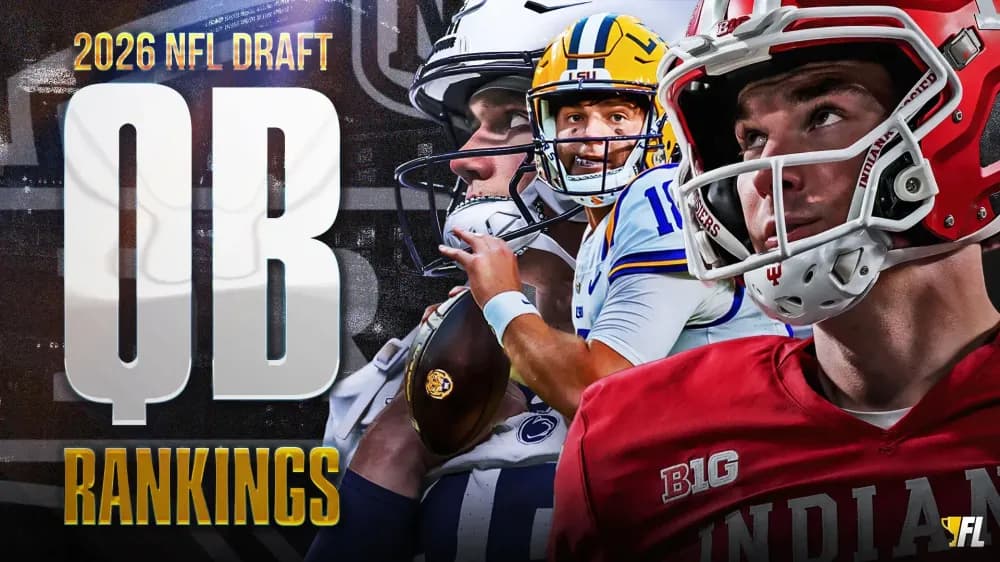
2026 NFL Draft Quarterback Rankings: Fernando Mendoza Stands Alone
Matthew Freedman unveils his top 13 quarterbacks for the 2026 NFL Draft
The Scouting Combine is officially behind us, which means each day we inch closer to the 2026 NFL Draft. With that being the case, over the next handful of weeks, we will be releasing our positional rankings for the 2026 draft class, starting with my 2026 NFL Draft quarterback rankings below.
As a reminder, for the 2025 draft, I was No. 1 in big board accuracy and No. 3 in mock accuracy. Since 2020, I'm the No. 1 mocker in the known universe.
For all of our draft coverage, check out our Fantasy Life NFL Draft Hub.
QB Rankings For The 2026 NFL Draft
1. Fernando Mendoza | Indiana | 6-5, 225 lbs. | rJR
Mendoza entered college as a run-of-the-mill three-star pocket passer but exited it as a National Champion and the winner of the 2025 Heisman Trophy and Maxwell, Walter Camp and Davey O'Brien Awards. Originally intending to play at Yale, Mendoza ultimately flipped to California, where he redshirted for a year before ascending to the starting role in the middle of his freshman campaign (1,708 yards, 14 TDs, 10 INTs on a 63.2% completion rate, 47-95-2 rushing in eight starts).
As a sophomore, Mendoza retained the starting job and built upon the success of his previous season (3,004 yards, 16 TDs, six INTs on a 68.7% completion rate, 87-105-2 rushing in 11 games), and then he entered the portal as a four-star transfer and signed with Indiana, where his younger brother (QB Alberto Mendoza) had just redshirted for innovative offensive HC Curt Cignetti.
In his first and only season with the Hoosiers, Mendoza looked like the best player in the nation (3,535 yards, 41 TDs, six INTs on a 72.0% completion rate, 90-276-7 rushing in 16 starts). And his stats weren't empty: Mendoza put up an FBS-best 10.8 AY/A and 182.9 Passer Rating while leading Indiana to a surprise undefeated season (16-0). Perhaps most importantly, he was at his best in the biggest moments with multiple statement wins in the postseason. With his breakout, Mendoza joined Matt Leinart (2004), Cam Newton (2010), Jameis Winston (2013) and Joe Burrow (2019) as the only QBs this century to win the Heisman and a national title in the same season. Impressive stuff.
As a prospect, though, Mendoza is probably more Leinart than Newton, Winston and Burrow. He has Leinart's pro-ready polish (which didn't translate to the NFL), but he lacks Newton's rushing ability, Winston's arm strength and Burrow's all-around aura. As an athlete, Mendoza is average at best.
But that doesn't mean he can't be a good NFL QB. Cignetti's system undoubtedly aided Mendoza, but he gets credit for learning the offense expeditiously and executing it perfectly. And despite his athletic limitations, Mendoza has the prototypical size to stand strong without blinking and enough arm and movement skills to navigate the pocket and distribute the ball with command like a veteran point guard.
When the structure of the offense remains intact, Mendoza dominates: He understands coverage, plays on schedule and consistently puts the ball on the upfield shoulder so his receivers can stay in stride. Cignetti's RPO and play‑action scheme demanded that Mendoza read leverage and trigger quickly, and he did exactly that with clean feet, a compact release, and little wasted motion. For NFL coordinators who want to live in second‑and‑manageable, Mendoza's short and intermediate ball placement will be a cheat code.
Mendoza's best attributes are probably his processing speed and poise. He's a fast post-snap assessor, which allows him to play ahead of most pressure, and he has steadily improved throughout his career as a pocket navigator with his sliding, climbing and resetting. Additionally, he has displayed a willingness to stand in the face of free rushers and deliver with accuracy. Panic heaves and YOLO balls are uncommon on his tape, and when he loses a rep, the result is usually a throwaway or sack, not an air-mailed turnover.
As a runner, Mendoza is more functional than flashy. He'll likely never be a featured part of the designed ground game in the NFL, but in college he was able to steal first downs as a scrambler and execute boots, keepers and the occasional zone-read carry. He doesn't create explosives with his legs, but he's also not a negative rusher.
The main question NFL teams will likely have with Mendoza is whether he can still produce when the play breaks down. Because of Cignetti's friendly system, Mendoza hasn't seen many out-of-structure snaps, and when he has, he hasn't inspired often with second-reaction magic. When forced off his spot, Mendoza has displayed little improvisational ability. While lethal, he's more of a sniper than a brawler.
Fortunately for Mendoza, many modern NFL playcallers want snipers, and as a prospect he's incredibly clean: Size, accuracy, timing, processing, big wins, no known off-field issues and a workmanlike temperament and demeanor. He's not guaranteed to be the first QB selected and No. 1 overall pick, but it'd be a surprise if he weren't.

Premium
Go FantasyLife+
Your league is unique. Your advice should be too. Get personalized tools, rankings, and projections tailored to your fantasy football league settings.
2. Ty Simpson | Alabama | 6-2, 208 lbs. | rJR
After the herky-jerky rollercoaster experience that was Jalen Milroe in 2024, Simpson was a comfortable midsized sedan for Crimson Tide fans in 2025. That's not terrible—but let's be honest: Sedans are serviceable, not luxurious.
For a first-year starter, Simpson was good (3,567 yards, 28 TDs, five INTs on a 64.5% completion rate, 90-93-2 rushing in 15 starts). He looked the way one would want a former five-star recruit to look: He played with rhythm, anticipation and sound fundamentals. He thrived in the quick and intermediate game with seams, digs and outbreaking routes. He protected the ball and took what the defense gave him.
But the shortcomings are apparent. Simpson has just one year of starting experience, and it's concerning that he couldn't beat out Milroe for the starting job in the 2023-24 seasons. His size is modest, and his rushing ability is almost nonexistent. His arm strength is average, and his accuracy, judgment and technique disappear under pressure. Perhaps most importantly, his play fell off in the second half of the season (6.5 AY/A in Games 8-15 vs. 10.3 in Games 1-7).
Simpson has potential, but right now he's more of a projection than a finished product, and his upside is more two-story suburban home than a big-city skyscraper penthouse. He could go in Round 1, but he belongs in Day 2.
3. Carson Beck | Miami (FL) | 6-4, 225 lbs. | rrSR
Beck did yeoman's work this past season in his lone Hurricanes campaign, leading an ascending program to a championship game while putting up good numbers (3,813 yards, 30 TDs, 12 INTs on a 72.4% completion rate in 16 starts).
Beck's strengths are clear: He's a big, rhythmic pocket operator who wins with brain, base and ball placement. A distributor by temperament, he's comfortable working full-field concepts and throwing with touch underneath and intermediate. With a clean pocket, he has the mechanical consistency to deliver the ball so only his guy can catch it. And he has a wealth of winning experience from his time at Georgia (2020-24, starter in final two seasons there).
But he's old for a rookie, and this past year, he was less polished and productive than one would want a sixth-year senior to be. On top of that, his arm strength is more solid than special, his ground game is a net negative (62-43-2 rushing in 2025) and he's at his worst under pressure, outside structure and on late-down deep throws: His shoulders open, base narrows, balls sail and decision-making stalls.
Whether he goes on Day 2 or 3, his most likely NFL outcome is a competent-but-common career-long backup.
RELATED: Carson Beck NFL Draft Scouting Report
4. Drew Allar | Penn State | 6-5, 235 lbs. | SR
Allar's season-ending ankle injury and final-year regression (career-low 7.1 AY/A) will push him to Day 2, but he has Round 1 tools with a Sunday frame and primetime arm. When clean, he's maybe the cohort's cleanest QB.
5. Garrett Nussmeier | LSU | 6-1, 205 lbs. | rSR
Son of Saints OC Doug Nussmeier, the smooth pocket passer has football in his DNA, but mediocre tools, size and ball protection. Plus, he regressed last year (7.9 AY/A in 2022-24 vs. 6.7 in 2025) and ultimately was benched. Long gone is last offseason's Round 1 hype.
6. Cole Payton | North Dakota State | 6-3, 233 lbs. | rSR
Payton is "upside" personified. With a rocket arm, he flashed last season in his lone starting campaign (71.9% completion rate). With his prototypical size, he bullied LBs and DBs as a dual-threat pugilist (136-777-13 rushing). He's chaotically raw and problematically inexperienced, but Payton is the kind of small-school boom/bust Day 3 dice roll with snake eyes potential.
7. Sawyer Robertson | Baylor | 6-4, 220 lbs. | rSR
Robertson has pedigree (four stars) and production (6,752 yards, 59 TDs passing in 2024-25), but his pocket slothiness (17 rushing yards last year) and gambler willingness (25 career INTs) make him a late-round backup.
8. Taylen Green | Arkansas | 6-6, 235 lbs. | rSR
A four-year starter, Green has arm strength and dual-threat skills (2,405 yards rushing for career), but he plateaued in college (7.6 AY/A in 2022, 8.0 in 2025). Inaccuracy and blunders make him a Day 3 flier.
9. Cade Klubnik | Clemson | 6-2, 210 lbs. | SR
A dual-threat five-star recruit who stagnated in three starting seasons (7.4 AY/A), Klubnik is athletically and mechanically adequate but schematically and progressionally challenged.
10. Diego Pavia | Vanderbilt | 5-11, 207 lbs. | Grad
Pavia is this decade's older, smaller, less-accoladed Johnny Manziel. He's a winner and gamer, but sloppy mechanics and Superman delusions make Pavia a Day 3 project.
11. Jalon Daniels | Kansas | 6-0, 220 lbs. | rrSR
With six years of intermittent starting experience, Daniels is a functional passer (8.5 AY/A since 2022) and runner (843 yards since 2024), but durability concerns and in-structure inconsistency will likely force him into Day 3.
12. Haynes King | Georgia Tech | 6-3, 215 lbs. | rrSR
A former four-star recruit, King's first three seasons at Texas A&M were derailed by injury and inefficiency, but he got back on track at Georgia Tech in his final three seasons (8.0 AY/A, 430-2,277-36 rushing in 36 games). A juiced-up dual-threat wildcard, King is a long-speed shipper with a live arm—but his turnover tendencies, streaky placement and gunslinger hubris make him a volatile Day 3 selection at best.
13. Miller Moss | Louisville | 6-2, 210 lbs. | rSR
Moss flashed in three seasons as a USC backup to Caleb Williams, Kedon Slovis and Jaxson Dart (11.4 AY/A), but then he stalled out in two campaigns as a starter (7.0). Cerebral, surgical and quick as a short-to-intermediate rhythm passer, Moss has subtle late-round upside, but his athletic juice has no pulp, and his rushing ability has no production (-65 yards last year).

Join Our Newsletter
Trusted by 400,000+ fantasy football players. Get access to Fantasy Life's free award winning newsletter and tools, all in one step.
By registering or logging in, you agree to our Terms of Use and Privacy Policy.