Risers and Fallers From The 2026 NFL Scouting Combine: Mike Washington Makes History
Matthew Freedman highlights who performed well enough for their stocks to rise, and whose stocks are falling after the 2026 NFL Scouting Combine
The 2026 NFL Scouting Combine is officially over, and oh boy—we saw some performances!
Who aced the event? Who flopped?
To answer these questions, I present to you my "unofficial" combine notebook.
But before I get into my position-by-position thoughts, I should give some overall perspective on the 2026 draft class first.
Reviewing The NFL Scouting Combine: All-Time Athletes in the 2026 Class?
At the combine, we saw some amazing athletic performances.
The DLs, LBs, DB and TEs: They all had position-best average 40-yard dash times relative to previous classes (going back to 2003). The same is true for the RBs (and the same might be true for other positions, too).
Does that mean this class is overflowing with athletic ballers?
Sort of, with an asterisk: Fewer players are participating in the athletic testing at the combine.
And is this random? No.
Generally, the dudes now participating in the combine are those who know they will do well.
I don't want to sell short some of the absolutely astonishing accomplishments we saw on Thursday through Sunday.
But we should keep in mind the following:
- Fewer prospects are participating in the combine's athletic testing than ever before.
- Prospects have gotten progressively better at training and preparing for the combine over the years.
- Athleticism doesn't correlate perfectly with future NFL production.
Entering the combine, this class had a run-of-the-mill reputation. While the depth for the class is good at some positions, the high-end talent suffers in a comparison with previous years.
Now that the best guys in this class have tested, do we suddenly have 46 first-round prospects?
No.
While some guys improved their draft stock, other guys (some of whom didn't work out) hurt their draft stock.
This class has some elite athletes and decent depth, but many of the first-round prospects still have significant questions—even if they no longer have to do with athleticism.
Where to Draft Each Position in the 2026 Draft Class
Exiting the combine, here are the positions I'd attack in the draft in various rounds if I were a GM. Framed differently: Here's why I think positions are likely to offer the most value this year.
- Round 1: EDGE, DT, LB, S
- Rounds 2-3: OL, RB, WR, TE, CB
- Round 4: QB, iOL, WR, TE, EDGE, S
- Rounds 5-7: Doesn't matter, draft for upside and need
Quarterback Risers From The 2026 NFL Scouting Combine
Ty Simpson (Alabama)
In my most recent mock draft, I don't have Ty Simpson included in Round 1. To my eye, he looks like a second-rounder.
But he did well with his on-field workout: He was accurate and displayed the ability to make all the throws to all levels of the field.
He's not big (6-1, 211 lbs.). He had just 15 starts in college. He did little as a runner this past season (90-93-2). And his play fell off in the second half of 2025 (6.5 AY/A in Games 8-15 vs. 10.3 in Games 1-7).
But Simpson will now almost certainly go as the No. 2 QB in the class after Fernando Mendoza, and that could happen in Round 1.
For the 2025 draft, I was No. 1 in big board accuracy and No. 3 in mock accuracy. Since 2020, I'm the No. 1 mocker in the known universe. For all of our draft coverage, check out our Fantasy Life NFL Draft Hub.
Cole Payton (North Dakota State)
In a recent episode of The Fantasy Life Show, Ian Hartitz and I broke down the 2026 QB class, and I mentioned that Cole Payton might be my favorite QB after Mendoza.
My comp for him is Tim Tebow (minus the big obvious stuff, such as college pedigree, long-term production and draft capital). Payton has good size (6-3, 232 lbs.), and then at the combine he exhibited great athleticism (4.56-second 40-yard dash, 1.57-second 10-yard split) and a strong arm in the passing drills.
And that matches with what we saw out of him last season: In his lone campaign as a starter, he passed with efficiency (71.9% completion rate) and bulled LBs and DBs with his dual-threat pugilism (136-777-13 rushing).
Payton is raw and inexperienced, but he's also upside personified.
If he ever gets a chance to start, he'll be a fantasy-relevant asset.
Quarterback Fallers From The 2026 NFL Scouting Combine
Taylen Green (Arkansas)
Taylen Green's likely to show up on many "winners" lists because of his outstanding athletic performance at the combine.
Green's not a small guy (6-6, 227 lbs.), but in Indianapolis he blazed a 4.36-second 40-yard dash and then leapt out of the stadium with a position-record 43.5-inch vertical jump and 11-2 broad jump.
That's nice … especially if he eventually transitions to WR, which he might need to do, because he didn't look good in his passing drills. He has arm strength, but his accuracy and technique are problematic.
Green's an awesome athlete, but he's probably not a real NFL QB.
Carson Beck (Miami)
Carson Beck is in competition with Garrett Nussmeier, Drew Allar and maybe even Cole Payton to be the No. 3 QB after Fernando Mendoza and Ty Simpson.
Nussmeier, Allar and Payton all helped themselves at the combine. Beck, though, struggled to throw with power on the move and with touch between the hashes.
And more importantly (I'm kind of joking, kind of not), he got booed by fans. Every time his face came up on the stadium screen, there were noticeable boos.
Is this a big deal? No. Is it funny? Yes. And might it matter a little bit? Possibly.
I'm just saying: Maybe the guy to become the first prospect ever to be booed at the combine isn't the type of person GMs and HCs will want on their rosters.
Running Back Risers From The 2026 NFL Scouting Combine
Jeremiyah Love (Notre Dame)
The 2025 Doak Walker Award winner did what he needed to do at the combine. Jeremiyah Love measured in with respectable size (6-0, 212 lbs.) and then blazed a 4.36-second 40-yard dash.
Within our Fantasy Life 2026 player rankings, we have him as our consensus No. 9 RB. (I'm the highest on him at No. 7).
With his verified legit speed, I expect to see him move up our fantasy ranks and go in the top 10 of the 2026 NFL draft.
To access our 2026 fantasy football ranks, use the promo code FREEDMAN for 20% off the FantasyLife+ package.
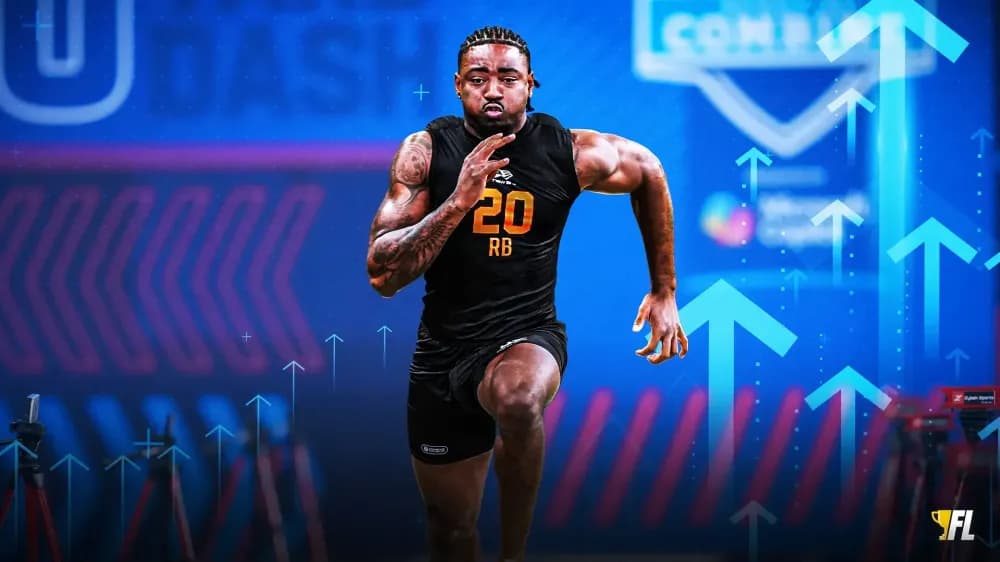
Mike Washington (Arkansas)
Mike Washington entered the combine with Day 3 expectations, but after he tore up the combine, he could go on Day 2.
He exhibited excellent:
- Size: 6-1, 223 lbs.
- Speed: 4.33 40-yard dash | 1.51-second 10-yard split
- Explosiveness: 39-inch vertical jump | 10-8 broad jump
Put that all together, and Washington (at least for now, with no agility testing) has the No. 1 RAS (10.0) for all RBs since 1987.
Last year in his lone season at Arkansas, he put up 1,296 yards and nine TDs on 167 carries and 28 receptions in 12 games.
He has potential.
Running Back Fallers From The 2026 NFL Scouting Combine
Jadarian Price (Notre Dame)
Jadarian Price didn't have an awful combine, but I expected more out of the guy who was the clear consensus No. 2 RB in the class.
While some guys were running the 40 in the 4.3s, Price managed a more pedestrian time of 4.49 seconds (at a modest 5-11, 203 lbs.). While that number is fine on its own, it's accompanied by a downright scary 10-yard split of 1.61 seconds (second-worst mark in the class).
With average speed and subpar burst, Price is no longer a lock for the No. 2 RB spot.
Emmett Johnson (Nebraska)
Emmett Johnson arrived at the combine with Day 2 hype, and it was warranted: Last year, he had 1,821 yards and 15 TDs on 251 carries and 46 receptions in 12 games.
But at the Combine, he measured small (5-10, 202 lbs.) and then ran slow (4.56-second 40-yard dash, worst in class). To make matters worse, he was the only guy to do the three-done drill … and then he put up an embarrassingly unagile mark of 7.32 seconds.
He could now fall to Day 3.
Wide Receiver Risers From The 2026 NFL Scouting Combine
Omar Cooper (Indiana)
Omar Cooper has gotten some recent Round 1 hype, and his combine numbers will only add fuel to the fire.
- Size: 6-0, 199 lbs.
- Speed: 4.42 40-yard dash | 1.55-second 10-yard split
- Explosiveness: 37-inch vertical jump
Cooper has inside/outside versatility, and last year he had 69-937-13 receiving and 3-74-1 rushing for the championship-winning Hoosiers.
Chris Brazzell (Tennessee)
Questions still exist for Chris Brazzell regarding his production: He broke out as the No. 1 WR for the Volunteers this past season (62-1,017-9, 12 games), but he also played in a stat-inflating system. Additionally, his technique and physicality are far from perfect.
But now no questions exist about his size/speed profile. He's not heavy (198 lbs.), but he is tall (6-4), and at the combine he ran the 40-yard dash in 4.37 seconds with a 10-yard split of 1.52 seconds.
As an athlete, Brazzell checks the box.
Wide Receiver Fallers From The 2026 NFL Scouting Combine
Carnell Tate (Ohio State)
Carnell Tate entered this past week as the consensus No. 1 WR in the class.
Now, he probably still is—but his lead has likely diminished.
In terms of his college production, Tate is similar to some big-time studs: Justin Jefferson, A.J. Brown and Jaxon Smith-Njigba.
But Tate underwhelmed at the combine with his relative lack of size (6-2, 192 lbs.) and speed (4.53-second 40-yard dash, 1.61-second 10-yard split).
On the one hand, Tate's game isn't necessarily predicated on speed, and his 40 time isn't atrocious.
On the other hand, all of the guys he's now being compared to—guys with suboptimal 40 times—were significantly bigger than he is now.
Tate could still very much have NFL success, but his odds of going in the top six now feel lower.
Malachi Fields (Notre Dame)
Malachi Fields had gotten a little Round 1 hype in the month leading up to the combine, but then he ran a sluggish 4.61-second 40-yard dash with a lethargic 1.63-second 10-yard split.
Fields has good size (6-5, 218 lbs.) and agility (6.98-second three-cone), but he's probably just too slow to win consistently on the perimeter in the NFL.
Tight End Risers From The 2026 NFL Scouting Combine
Kenyon Sadiq (Oregon)
Kenyon Sadiq solidified his first-round status with his elite athleticism.
He's smaller for a TE (6-3, 241 lbs.), but he's fast (4.39-second 40-yard dash, 1.54-second 10-yard split) and explosive (43.5-inch vertical jump, 11-1 broad jump). He has a real shot at going in the top 10.
Eli Stowers (Vanderbilt)
Eli Stowers is even smaller (6-4, 239 lbs.) than Sadiq, but he's also fast (4.51-second 40-yard dash, 1.59-second 10-yard split) and especially explosive (combine-record 45.5-inch vertical jump, 11-3 broad jump).
The 2025 John Mackey Award winner, Stowers now seems locked in as the No. 2 TE in the class.
Tight End Fallers From The 2026 NFL Scouting Combine
Honestly … I'm not sure there actually are any TE fallers.
Non-Skill Position Risers From the NFL Scouting Combine
- LB Sonny Styles (Ohio State): Athletic freak
- EDGE Arvell Reese (Ohio State): Ditto
- EDGE David Bailey (Texas Tech): Good 40 time (4.50 seconds)
- DT Caleb Banks (Florida): Elite size (6-6, 327 lbs.)
- DT Kaleb Proctor (Southeastern Louisiana): Top-five in 40 and jumps
- LB Anthony Hill (Texas): Legit speed (4.51-second 40)
- CB Colton Hood (Tennessee): Checks the box on speed (4.44-second 40)
- S Dillon Thieneman (Oregon): Might go in the top 20 with speed (4.35-second 40)
- S Bud Clark (TCU): Top-five in 40 and jumps
- S Lorenzo Styles (Ohio State): Sonny's brother, position-best speed (4.27-second 40)
- OT Spencer Fano (Utah): Blazing speed (4.91-second 40)
- OT Kadyn Proctor (Alabama): Showed up at ideal weight of 352 lbs.
Non-Skill Position Fallers From The NFL Scouting Combine
- EDGE Reuben Bain (Miami): Confirmed T. Rex arms (just under 31 inches)
- EDGE Cashius Howell (Texas A&M): He's fast, but his arms are somehow shorter than Bain's arms (30.25 inches)
- EDGE R Mason Thomas (Oklahoma): He's not fast enough (4.67-second 40) for his small size (6-2, 241 lbs.)
- DT Lee Hunter (Texas Tech): Bottom-two at position in 40 and jumps
- CB Jermod McCoy (Tennessee): Given that he didn't play in 2025, it feels like a red flag that he didn't participate in the combine

Join Our Newsletter
Trusted by 400,000+ fantasy football players. Get access to Fantasy Life's free award winning newsletter and tools, all in one step.
By registering or logging in, you agree to our Terms of Use and Privacy Policy.