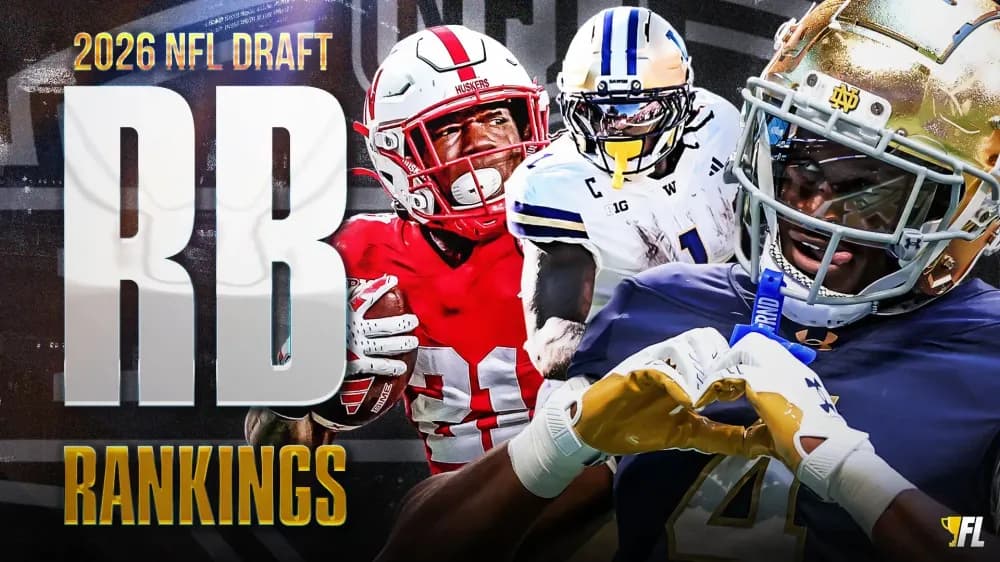
2026 NFL Draft Running Back Rankings: How High Will Mike Washington Climb?
Gene Clemons breaks down his top-20+ running backs in the 2026 NFL Draft Class.
We're entering the best part of the offseason—the lead-up to the 2026 NFL Draft. With the Scouting Combine behind us, free agency right around the corner and mock drafts flying left and right, it's time to break down my 2026 NFL Draft Running Back Rankings.
ICYMI: Matthew Freedman's QB Rankings for the 2026 NFL Draft
RB Rankings For The 2026 NFL Draft
1. Jeremiyah Love | Notre Dame | 6-0, 215 lbs. | JR
For a defender, watching Jeremiyah Love attack the second level of a defense with the ball in his hands is like being in a BMW driving on the interstate and watching a Bugatti cut you off and fly past you. I’m sure you want to be mad, you want to chase after them, but you know, they are gone! There’s no reason to risk injury or embarrassment chasing behind them. This is a feeling defenders across the college football landscape have felt over the past two seasons since Love has truly come into his own in the backfield. He is a back that forces you to play seven in the box because of his ridiculous burst. He turns creases into explosives and Sunday morning film session nightmares. Just ask USC, which had to watch him race to 228 yards on 24 carries. That included a 63-yard run that set up the team’s first touchdown. The only thing more incredible than his performance was that someone actually caught him on that play. He does not just have speed; he has acceleration that has been weaponized.
His talent is not simply in his legs but in his eyes as well. He can make cuts with surgical precision, whether it is setting up blocks and using them at just the precise time or setting up defenders who think they have him dead to rights, only to reach out and grab nothing but air. The zone running scheme of Notre Dame fits him perfectly, and the NFL teams that employ a similar style of rushing attack will be salivating to get him in the building. Against Texas A&M, he was constantly allowing his linemen to stack defenders, pressing the hole and then exploding through the hole when it was exposed to him.
His contact balance is also extremely impressive. Just when a defender thinks he is going to bring him down, Love can churn forward for more yards as if there is some magnetic force dragging him forward. In their 2024 matchup with Indiana in the College Football Playoffs, he was able to stay upright despite a defender hitting him around the legs. Some backs would have lost their balance and been tripped up, but he kept churning and 98 yards later was blowing kisses in the endzone.
Does he operate the best in every run scheme? No, that is a product of exposure. He has been running a zone scheme. Does he do the best job in pass protection? No, again, that is opportunity and understanding. Those things will improve with time and attention to those details, but this is a plug-and-play guy like we have seen take over the past few seasons.

Premium
Go FantasyLife+
Your league is unique. Your advice should be too. Get personalized tools, rankings, and projections tailored to your fantasy football league settings.
2. Mike Washington Jr. | Arkansas | 6-2, 223 lbs. | Jr
Washington is a big, strong and highly efficient running back. He started his collegiate journey as a member of a committee at Buffalo for three seasons before transferring to New Mexico State, where he ran for a career-best 725 yards and eight touchdowns. He transferred to Arkansas for his final season and proved he could be highly effective in the best conference in college football, the SEC. He finished the season rushing for 1070 yards and eight touchdowns on only 167 carries. That is a ridiculous 6.4 yards per carry against elite collegiate competition. There is no doubt that Washington can hold his own with the best in the nation.
It is the motor that makes Washington so good; it just keeps running while he is running. Imagine having to stop a back of Washington's size, then imagine having to do it while that back brings you the same intensity every rep, all game. It is exhausting and wears down defenders who are not used to that level of consistent grind from a running back. He runs with aggression and passion like someone who feels he has to prove himself on every rep because, as a guy who worked his way from the MAC to the SEC, he likely does. So many backs are out here waiting to be hit or waiting to see what the defense does, not Washington. He is not a counter-puncher; he leads with the hook like Smoking Joe Frazier used to back in the days of Muhammad Ali. All aggression, all the time.
One of the elements he began to explore more at Arkansas was his ability to catch passes out of the backfield. He had 28 receptions for 226 yards and a touchdown. Refining his receiving could be the key to unlocking his fullest potential at the next level. It will certainly be something he will emphasize in his preparation for the evaluation circuit.
RELATED: Washington's history-making Combine performance lands him among the biggest NFL Scouting Combine Risers.
3. Jadarian Price | Notre Dame | 5-10, 195 lbs. | Sr
Price is a talented slasher in a backfield where he was part of a tandem where team success was based on their in-game effectiveness. He is a do-everything back who will outlast the average NFL back's lifespan because of what he does. He can have value in multiple schemes and provides value on special teams. One of the best things about Price is that he was not handed a role; he clawed his way up from special teamer and tore reps away from his running mate, Jeremiyah Love, because of his effectiveness.
Price is a patient runner who understands how to press a hole and commit to his aiming point until a defender commits, and then can quickly cut off the block he helped create. It is a patience that can frustrate defenders, especially because of how explosive he can be when he hits the hole and speeds through rushing lanes. It only gives the defender at the point of attack a moment to react, and usually by that time, it is too late, and Price is flying by just in time for the defender to hit him on the hip like he's trying to reach into Price's pockets.
His home run hitting ability, mixed with his smooth hands and physical toughness, makes him a value in all phases. It is why he will be so valuable in the NFL. You can split him out wide and send him on vertical routes to stress the secondary, or throw him a swing pass or screen and let him run after the catch. Also, with the NFL's new kickoff rules, he will be a weapon as a kick returner who is tough enough to take a big hit, patient enough to allow his blocks to set up, but explosive enough to exploit the openings when they appear.
He will want to add more size to what will be considered a slender frame by NFL standards. It will help with his durability and allow him to bring more pop when he has to deliver the hit. That is nothing an NFL strength and conditioning program can't handle.
4. Jonah Coleman | Washington | 5-9, 230 lbs. | SR
Coleman may not be in your traditional power back package because he is only listed at 5-foot-9, but do not let the lack of height fool you; he is a tightly wound package of explosives that is ready to detonate at any moment. He is a small powerhouse who catches defenders trying to arm tackle and runs through them regularly like a bowling ball through pins. In an NFL that does not see a bunch of bull dozers in the backfield anymore, Coleman would be a welcome sight. He has the makings of an every-down battering ram back.
It is difficult to get Coleman down on the first hit because he has great contact balance. He is built like a fire hydrant with wide-profile wheels. Because of mediocre quarterback play, he has faced a ton of seven-man boxes with attention being solely focused on him. So he has worked to be comfortable with being a human pinball bouncing off defenders while continuing to move forward. This season against Ohio State, although they lost 24-6, he ran 13 times for 70 yards as he ricocheted off defenders. He did the same thing against Illinois this season as well.
He is a powerful running back who utilizes brute force to punish defenders and pick up extra yards. There have been many times this season where he has to BYOB, “bring your own block”, and he has done that. This season against Colorado State, he was trucking defenders like a Tecmo Bowl character. He finished with 149 of his 177 yards coming after contact. He has been bowling over defenders for the past two seasons.
You would think a running back that relies so much on brute strength and power would probably not be the most patient runner. That is why Coleman has had so much success. He has the patience necessary to set up blocks and burrow through the lane created. He also does a good job of seeing the cutback lanes and exploiting them. In the LA Bowl against Boise State, he was running an inside zone play going right and noticed that the C-gap defender tried to duck inside the block. Coleman immediately bounced outside and ran it in for a touchdown.
Coleman is not slow, but he is not a burner. He has great short-distance burst, but his breakaway speed leaves a little to be desired, so he will need to work on improving that top-end speed. There is also something comforting about him being a consistent single and double hitter; he does a good job of staying above the line of scrimmage.
5. J’Mari Taylor | Virginia | 5-10, 204 lbs. | JR
Taylor may be one of the most underrated running backs in the nation. He started his career at HBCU powerhouse North Carolina Central, where he spent the first four years of his collegiate experience. In his final season for the Eagles, he rushed 196 times for 1,146 yards and a massive 15 touchdowns. Last season, he took his talents to Virginia, where he proved once again that he could be a bell cow back at the highest level in college, carrying the ball 222 times for 1,062 yards and 14 touchdowns. He finished the regular season as the leading rusher in the ACC. The consistency from the FCS to the Power Four has completely raised the profile of Taylor and should convince scouts that he can handle the rigors of the NFL.
Taylor is a slick runner who understands when to employ his speed and when to use his force. He sets up blocks well and navigates rush lanes with ease. What you really like about Taylor is his demeanor while running the ball. If he is not having success, he does not get discouraged; instead, he just keeps plugging away, knowing that all he needs is a crease to break one big or just pick up a momentum-changing chunk of yards.
6. Demond Claiborne | Wake Forest | 5-10, 195 lbs. | SR
If you are looking for a bruiser, then you may need to look at other backs besides Claiborne. If you are looking for an effective back who knows how to navigate rush lanes, set up blocks and consistently win against bigger, more physical defenders, then you are looking for the Demon Deacon senior rusher. He is an explosive back who can cut on a dime and is deadly out on the perimeter. He has improved his rush efficiency every season from his freshman season to his senior year. He averaged 4.1 yards per rush as a freshman and 5.1 as a senior. He also produced two consecutive seasons of double-digit touchdowns, which speaks to his nose for the end zone.
The secret to his game is his magician-like quickness; he can stop, change direction, accelerate, cut on a dime and leave 10 pennies in his wake. He is usually one move ahead of a defender who is usually relying on physicality and brute force to bring him down and he does a great job of using a defender’s aggressiveness against him. It is human teleportation that he is able to jump-cut and get away from a defender. Against Georgia Tech, he washed them for a 27-yard touchdown run on a run play designed to hit in the A-gap, but when he saw that defenders were all attacking the gap, he jumped two gaps over and exploded past two defensive backs trying to close in on him and another defender diving as his heels. That is the type of agility he brings to the table.
His size may be seen as a limitation in the NFL and pigeonhole him as a complementary back, which is unfortunate because size is not a skill but if that does happen, he will be one hell of a complement. He has so much untapped potential as a pass receiver because Wake Forest just did not utilize him in that manner. Over his final two seasons, he caught 51 passes for 394 yards and two touchdowns. In his first two seasons, he had four receptions. He will also be a great addition as a kickoff return man. It was something he did really well in a limited role in 2023 and 2024, where he returned 21 kickoffs for 561 yards and two touchdowns.
7. Le'Veon Moss | Texas A&M | 5-11, 215 lbs. | SR
Moss is track speed, personified! He has an explosive first step, like he is shooting out of the blocks. He knows how to explode through open holes and his acceleration allows him to separate from would-be defenders in the open field. He can cut on a dime and fly through a hole and he can be a menace on the perimeter. Over his career, he has averaged 5.5 yards per carry, which speaks to his explosive home-run-hitting ability. His combination of size with that speed makes him a problem for any defensive coordinator to gameplan against in today's hyperfast football landscape, where offenses have a million ways to get the ball into the hands of weapons like Moss regularly.
Moss should be looked at like a guided missile; aim him where you want him to go and then turn him loose. That is where he is at his best. He is a gap- and man-scheme style of back that will utilize his one-cut-and-explode nature to the best of his abilities. He just explodes past defenders who do not attack the hole with their full body. Arm tackles do not have enough time to work against Moss. The amount of force that he generates makes him more physical than maybe he even wants to be. There is no way to avoid it with 215 pounds moving that fast.
There will be questions about whether he can carry the full load at the next level. He only played in six regular-season games before an injury cost him the remainder of the season. In 2023 and 2024, he only played in nine games, so the concerns will be legitimate, but nobody will deny the weapon they have at their disposal if he is in the game.

Join Our Newsletter
Trusted by 400,000+ fantasy football players. Get access to Fantasy Life's free award winning newsletter and tools, all in one step.
By registering or logging in, you agree to our Terms of Use and Privacy Policy.
8. Emmett Johnson | Nebraska | 5-11, 205 lbs. | SR
Johnson's performance took a giant leap forward in 2025. His 251 carries were more than double his 2024 carries, and his 1,451 yards are nearly 2.5 times his 2024 total. The most impressive part is that he still increased his yards per carry from 5.1 last season to 5.8 this year. Those numbers describe a back that is able to win with superior vision, explosiveness and competitive spirit. He is a zone scheme wizard as a runner and he has the potential to expand his game as a pass receiving back. His efforts allowed him to lead the Big Ten in rushing this past season and be named Big Ten Running Back of the Year ahead of several members of this draft class at the position.
Johnson may not be the most elusive back, but he understands how to pick up chunks of yards at a time. He knows how to position his body so that defenders do not get the cleanest of hits on him, which allows him to pick up extra yards. He also understands how to keep his feet moving on contact, which helps to find more yards when he is wrapped up. He is constantly falling forward, which speaks to his physicality and the way he finishes runs. His performance against UCLA this season flashed his ability to be a highly productive all-around back. He ran for 129 yards and a touchdown, but he also caught three passes for 103 yards and two touchdowns. That included a 56-yard screen pass where he had to pluck the football out of the air, turn and set up his blockers, stiff-arm a defender while keeping his feet in bounds and dart up the field for a touchdown.
9. Adam Randall | Clemson | 6-3, 232 lbs. | SR
Adam Randall adds so much more value than if you just think of him as a big power back. That sells him short of what he can be at his zenith. Yes, at 6'3" and 232 lbs, he brings significant size, but his receiving background promises the ability to be a plus receiver out of the backfield. He is still relatively new to the position, having spent only one season as a full-time running back. That means he is still learning all the subtle nuances of the position, and we could see his production increase exponentially as he becomes more comfortable in his new role.
It is a raw piece of clay for an NFL running backs coach to work with: a player with receiving ability, size and quickness coming out of the backfield, combined with the naivety of believing he can do anything any running back can do. He is a one-cut runner that works perfectly in zone schemes and in gap schemes that are prevalent throughout the NFL. He does a great job of pressing the hole and then exploding to pick up extra yardage. Look for him to be immediately effective out of the backfield, separating from linebackers and overwhelming safeties with his size and soft hands.
10. Nicholas Singleton | Penn State | 6-1, 225 lbs. | SR
For a back the size of Singleton, it's impressive to see him be such a burner—he's logged at least one 40-yard run in each of the past two seasons. He explodes through the line and transitions into his drive phase like a seasoned sprinter navigating a 60-meter dash. For Singleton, his 2025 was filled with team trauma, injuries and coaching changes, which did not allow him to generate the same type of numbers as the previous three seasons, two of which were 1,000-yard campaigns. During his freshman year, had a 70-yard touchdown run against Ohio, a 53-yard touchdown jaunt against Auburn and an 87-yard scoring sprint against Utah when they were the eighth-ranked team in college football with one of the best defenses in the country. He's been running away from defenses ever since.
He has a really strong lower body that is not only used to explode for long runs, but it also allows him to play through contact. He does a good job of keeping his legs churning for extra yards when he encounters resistance. It is the “grind it out” part of his game that is underrated. Running in the Big Ten is a difficult proposition, even with some of the Pac 10 teams entering the conference. His lower-half power makes him a great short-yardage and goal-line back, especially with his ability to sink his hips and explode through small openings.
He has shown improvement in his vision in traffic. Although his production has dropped this season, you can see the work that he has done to get better at recognizing openings is noticeable. It will make him a better fit in zone schemes as he moves on to the next level, already being a guy who excels in gap and man schemes. It also helps that he understands how to work in a tandem backfield. He and fellow 2026 prospect Kaytron Allen have been together for years at Penn State, so he will understand how to do his work on limited touches and make the best of it, but he also can carry the load. Like a lot of backs, he will need to refine his pass protection in the pros to maximize his usage on third downs, especially because he is likely to be drafted by a team that pairs him with another back. That fight for snaps will make him an even more valuable NFL asset.
11. Justice Haynes | Michigan | 5-11, 205 lbs. | JR
Haynes only played in seven games this season before losing the remainder of his season to injury. In his time on the field, his impact was massive. In six of the seven games he played in this season, he has run for over 100 yards and scored at least one touchdown. His production was very impressive this season, rushing for 857 yards and 10 touchdowns on only 121 carries.
Haynes averaged a ridiculous 7.1 yards per rush this season and one of the primary reasons is his vision. He has the ability to anticipate where the hole will open as if he were blessed with the ability to predict the future. It allows him to make cuts faster through quickly closing open holes and off blocks that don't need to be sustained long. It also allows him to set up blockers to make cuts off or keep defenders from getting full contact hits on him. Many times, his cuts keep defenders from getting their hands on him at all, especially in the open field. They are sudden and surgically sharp. In the Oklahoma game, he broke loose for a 75-yard touchdown run after running right, but saw an open rush lane to the left, which he was able to jump cut and take off out the back side.
Another great attribute is his contact balance. He carries his pad level low when he runs. It keeps his center of gravity lower to the ground, which allows him to keep his balance when he is hit going through the hole, and it allows him to keep his feet and explode for extra yards after contact. In their game against Oklahoma, he was bouncing off defenders like a human centipede as he continued to churn out yards. In many instances, he was getting hit at or just beyond the line of scrimmage, but continued to gain ground.
That ability to gain ground does not just come from his low center of gravity and pad level, but it is also due to his insatiable desire to gain yards. An uncanny ability to finish runs. His physical running style and his finishing ability allow him to pick up extra yardage and wear down defenses. Against Oklahoma, the beginning of the game started with him being hit for one and two-yard gains, and that turned into eight- and 10-yard runs as he continued to batter that Sooner defense.
He still needs to improve his pass receiving skills or just have an ability to show them, but it will be a point of discussion when deciding how he will be utilized in the NFL.
12. Darius Taylor | Minnesota | 5-11, 210 lbs. | JR
Taylor is a great inside runner with scheme versatility who has proven to be a dual threat as a receiver out of the backfield. In his three seasons at Minnesota, he has over 2,300 yards rushing and over 660 yards receiving. Ever since he burst on the scene as a freshman with over 190 rushing yards against Eastern Michigan, Northwestern and Bowling Green, people have been thinking about how his game would translate to the NFL. Right now, he is kinda a jack of all trades and master of none with the potential to reach mastery.
Right now, the best attribute for Taylor is his vision and patience on inside runs. He is not wasteful in his movement; he sees the opening and hits the opening. He does a good job of not being slow to the hole to allow his blockers to do their jobs and get a body on a body before he accelerates through the hole or off a block. In the outside zone scheme, he does a good job of stretching out the defense so that he can locate a run-through lane. He also does a great job of keeping his eyes on the point of attack and judging if the defender loses the outside leverage, so he can get around the edge and pick up extra yards. His touchdown against Nebraska was a great illustration of this skill. Minnesota was on the goal line in a heavy package, and Taylor came downhill under control and watched as the defense pinched inside. He then bounced outside to the left and strolled into the endzone with ease.
Taylor has exhibited good contact balance. It allows him to run through arm tackles or bounce off defenders who only hit with their shoulders and try to knock him down. Taylor can churn out more yards after contact and consistently pick up a new set of downs for his offense. He can glide off hits as he picks up more yards. During his 75-yard run against Nebraska, he was able to display that balance. He ran through a rushing lane and was able to brush off a Huskers linebacker with the flick of his arm and took off to the right, where he stepped out of another potential tackle. That play also showed his need to improve his long speed in the open field; he was unable to score a touchdown on the play, and he was stopped at the one. That is something scouts will knock about his game, but he will work in the offseason to improve that aspect.
13. Kaytron Allen | Penn State | 5-11, 220 lbs. | SR
Allen is a highly productive collegiate running back who has been one of the best in college football without ever having a backfield to himself. He is a big, strong, physical back who is an aggressive runner who has produced against competition with NFL talent everywhere. He has rushed for over 4,100 yards over his four-year career and has improved his offensive output every single season of his time at Penn State. He went from over 860 yards as a freshman to over 1,300 yards as a senior. He held off a supremely talented Nicholas Singleton in the same backfield.
One of the primary ways he was able to hold Singleton off is because he's one of the most difficult running backs to bring down in college football. The way he's able to keep his feet through initial contact and not throw his balance off is why he's so effective as a runner. He bounces off would-be tacklers like they are riding bumper cars at the county fair. He is able to be hit and not lose speed as he ricochets away from the contact.
His massive production over the years, despite having to share the backfield with someone else, is his ability to gather yards after contact. While a portion is due to his excellent contact balance, it is how he is able to combine a substantial lower body and leg drive with a determination to keep moving forward. When he contacts a defender, he looks to deliver the hit; he is not bracing for the tackle. That allows him to run through arm tackles with relative ease. Rarely do you see the first defender bring him down because when he contacts a defender, regardless of the contact, he keeps his feet moving. Defenders have a tendency to hit and lunge through, but that means Allen stays upright because he is constantly moving.
He has a lot of work to do to prove he can be a good receiver out of the backfield, but nobody should question him about his ability to run the football.
14. Jaydn Ott | Oklahoma | 6-0, 210 lbs. | SR
Ott is a dynamic running back with elite explosiveness whose collegiate trajectory has been derailed over the past two seasons by injury. His first two seasons at Cal were as dynamic as any back you could name. He ran for over 2,200 yards and 20 touchdowns with an average of 5.3 yards per carry. The 2024 season began his injury woes, and they continued in 2025 after he transferred to Oklahoma. If healthy, he could be one of the best finds in all of college. He has good size, great speed and explosiveness, to go with potential receiving ability and a creative running style that leaves him always hunting for the home run. He also seems to have durability issues that will likely decide whether or not a team is willing to spend major draft capital on him.
15. Jeremiah Cobb | Auburn | 5-11, 195 lbs. | SO
Cobb may not be the biggest or most powerful running back in this draft class, but he has a great combination of speed, explosiveness and toughness that has fueled his breakout 2025 season at Auburn. He has pass-catching skills that will continue to emerge more with opportunities. He is a back who does a quality job of accelerating through running lanes and away from defenders. He has enough short-area quickness and change of direction to keep things off balance for linebackers in the box or defenders on the edge trying to decipher where the back is going in the outside zone. If he catches an edge, he's gone!
16. Terion Stewart | Virginia Tech | 5-9, 220 lbs. | SR
Stewart is one of the most difficult backs to bring down at the Power Four level. He spent his first four seasons at Bowling Green operating like a bowling ball, destroying pins all over the MAC. This season, he took his talents to Blacksburg, Virginia, to play for the Hokies. On a team where the quarterback was the leading rusher, Stewart was a big part of generating long drives and picking up critical first downs in their offense. He averaged 5.7 yards per carry at Tech, which went well with his overall career 5.9 average for his career. He is not seen as a burner, but he does have long runs on his resume, including an 85-yard dash this season against NC State. In true Stewart fashion, it was filled with broken tackles and guys bouncing off him like mosquitoes on a bug zapper.
17. Raleek Brown | Arizona State | 5-9, 195 lbs. | JR
After spending his first three seasons in college as an afterthought, Brown entered the 2025 season (his second at Arizona State) in what seemed like it would be a committee. His 18-carry, 110-yard effort against Mississippi State in their second game of the season left little doubt that Brown would be the featured back for this Sun Devils offense. He is a dynamic running back who packs a lot of explosiveness and big-play ability into a small package. His 1,141 yards and 6.1 yards per carry speak to his explosiveness. His 34 receptions point to a back that can affect the game as a runner and pass receiver. His ability to make people miss in close quarters or in the open field is what makes him so intriguing.
18. Marquis Gillis | Delaware State | 5-11, 210 lbs. | SR
Gillis is one of the most explosive running backs in the draft. He was the lead back in one of the best rushing offenses in the FCS. He carried the ball 182 times for 1,166 yards and eight touchdowns. He ran for over 100 yards in seven of Delaware State’s 12 games this season. That includes a 123-yard day against Delaware, which just recently moved to FBS, and a 159-yard performance against the eventual Celebration Bowl champions South Carolina State. He has speed to burn and a frame built strong enough to make you feel it if you get in his way. He only had a chance to show glimpses of his pass-catching abilities and should impress during all of the pre-draft workouts. The lack of power four competition will hurt his perception, but that is only until people see him in person.
19. Noah Whittington | Oregon | 5-8, 205 lbs. | rrSR
Whittington brings a certain professionalism and maturity to the running back position. After two seasons at Western Kentucky, he transferred to Oregon and spent the next four as a main cog in a running back rotation that exploited defenses with their versatility. In 2025, he became the man after serving as the number two to Bucky Irving and Jordan James, both backs who are now in the NFL. He plays with a low center of gravity that does not allow defenders to get clean shots on him. He does a great job of running behind blocks, setting them up and exploding off the contact. He is a guy who understands how to be efficient with his touches and would be a great addition to a committee or as a complementary back.
20. Josh Pitsenberger | Yale | 6-0, 215 lbs. | SR
Some may try to discount Pitsenberger based on the competition he has faced in the Ivy League as well as the FCS, but there is no denying the desire and physicality, toughness and intelligence they play with in the Ivy League. That's why when you see Pitsenberger running through defensive linemen, around linebackers and over defensive backs, you know he is a bonafied dog. As the Yale team captain, he more than doubled his 2024 production en route to 1,571 rushing yards and 19 touchdowns. His lasting legacy will be putting the entire Ivy League on his back in the FCS playoffs. In the first round, he brought the team back from a 28-point deficit by running for 209 yards and three touchdowns to stun Youngstown State and keep the league from going 0-2 in their first postseason appearance. The next week, he ran for 124 yards and a touchdown against eventual FCS Champions Montana State. He has the vision, explosiveness and balance to be a quality back. His long speed remains a mystery against elite competition, but it will be something he is working on.
21. Shomari Lawrence | Missouri State | 6-0, 200 lbs. | rrSR
Lawrence is a sixth-year senior who, after a three-year stint in the FCS's premiere conference and two years at Florida International, finally found his opportunity for a breakout season at new FBS member Missouri State, where he rushed for 1,021 yards and seven touchdowns while helping the Bears to a 7-5 record and an Xbox Bowl berth. He is a very physical and mature runner who has breakaway speed to pair with his experience, although he needs to improve on his natural vision. He has a frame that could still hold more weight, and the key will be deciding how much is too much, where his growth hurts his speed and ability to cut. His dynamics as a runner, along with his size/speed profile, make him an intriguing prospect who does not have as much mileage as one would expect a six-year back to be as dynamic as him to have.
Join Our Newsletter
Trusted by 400,000+ fantasy football players. Get access to Fantasy Life's free award winning newsletter and tools, all in one step.
By registering or logging in, you agree to our Terms of Use and Privacy Policy.